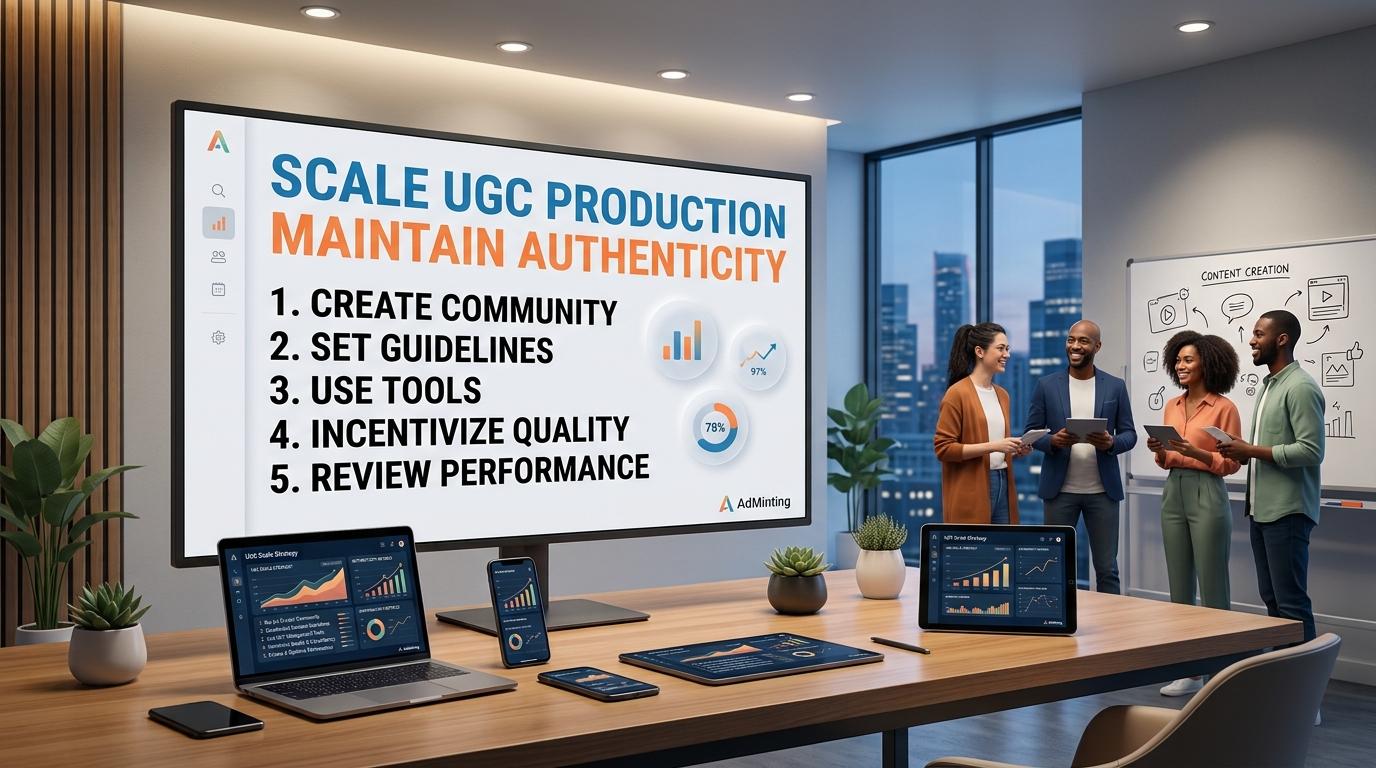
How to Scale UGC Production Without Losing Authenticity

Chukwunyere Ebube
November 16, 2026
How to Scale UGC Production Without Losing Authenticity
Did you know that shoppers are 2.5 times more likely to view user-generated content (UGC) as authentic compared to traditional brand-created advertising, yet over 80% of brands experience a sharp drop in conversion rates the moment they try to scale their creator output? Across Nigeria and the broader African continent, where the creator economy now boasts over 250,000 active creators in Nigeria alone and is projected to surge toward an $18 billion valuation across Africa by 2030, brands are pouring unprecedented budgets into short-form video.
However, here is the painful trap almost every growth team falls into: the very moment you try to turn one viral creator video into fifty monthly ad assets, the magic evaporates. Over-scripted lines, rigid corporate guidelines, and homogeneous creator casting quickly turn relatable storytelling into stiff "performance theater" that audiences scroll right past.
In this comprehensive guide, we are going to dismantle the myth that volume kills trust, showing you the exact operational frameworks, modular briefing systems, and regional sourcing strategies needed to scale UGC production sustainably. Jjoin me as we explore how to build an always-on UGC growth engine that converts.
Let me share a quick story that illustrates this exact bottleneck. Early in 2026, a fast-growing fintech startup based in Yaba, Lagos, decided to overhaul its customer acquisition strategy. Initially, they partnered with three micro-creators from Surulere and Lekki to film casual, smartphone-shot videos explaining how they used the app to split restaurant bills and pay utility tariffs without hidden bank charges.
Those three videos were magic, customers felt like a trusted friend was giving them a financial life hack, driving down customer acquisition costs (CAC) by 38% in just four weeks. Naturally, the executive team wanted more.
They immediately increased their monthly creative budget fivefold and demanded 40 new videos a month. To keep up with the sudden volume, the marketing manager wrote a strict, word-for-word 45-second script, mandated specific studio ring-light setups, and forced every creator to recite three rigid product bullet points in the first five seconds.
Within two weeks, click-through rates plummeted, comment sections filled with jokes about "paid actors," and ad fatigue set in faster than ever before. They had successfully scaled production, yet they had completely suffocated the human soul that made the content work in the first place.
By the end of this post, you will learn how to avoid that exact trap by building a repeatable, high-volume UGC production pipeline that preserves raw human trust. Specifically, you will master the architecture of tiered creator networks, discover how to write modular creative briefs that guide rather than dictate, learn how to balance human emotional storytelling with AI-assisted iteration, and see how to price, manage, and measure UGC campaigns effectively across Nigerian, African, and global markets.
How Do Brands Scale UGC Production Without Losing Authenticity?
To scale UGC production without losing authenticity, brands must stop treating user-generated content like a series of one-off viral campaigns and start building an always-on content infrastructure that standardizes operational workflows while protecting creative freedom. In other words, you standardize the system, how you source creators, structure briefs, manage usage rights, and test variations, while leaving the execution, the slang, pacing, camera angles, and personal anecdotes, entirely in the hands of the creator.
When you separate rigid operational guardrails from fluid creative expression, you unlock the ability to produce dozens of high-converting assets every month without ever sounding like a corporate commercial.
Why Traditional Scaling Breaks User-Generated Content
Before we build the solution, we need to understand why conventional marketing instincts fail so spectacularly when applied to the creator economy. Most brand managers are trained in traditional advertising, where consistency means controlling every pixel, syllable, and lighting cue. However, UGC operates on an entirely different psychological frequency.
1. The Over-Scripting Trap (Killing the Native Cadence)
Over-scripting occurs when brands provide creators with rigid, word-for-word teleprompter scripts, mandatory facial expressions, and exact framing instructions in an attempt to guarantee brand safety and message consistency across high volumes of videos.
Audiences on TikTok, Instagram Reels, and YouTube Shorts have developed hypersensitive "ad radars." Research shows that consumers spend an average of 5.4 hours daily engaging with authentic digital content, and they can spot unnatural phrasing within the first 1.5 seconds. When a creator in Abuja or London reads corporate copy that does not match their natural cadence, subconscious viewer rejection occurs immediately.
Replace word-for-word scripts with bulleted talking points and hook frameworks. Give creators the core problem, the specific product benefit, and the desired call-to-action, then explicitly instruct them to translate those points into their own everyday vocabulary, local Pidgin, or regional vernacular.
2. Creator Churn and Homogeneous Casting
Homogeneous casting happens when a brand repeatedly hires creators who share the exact same demographic profile, aesthetic background, and high-energy delivery style, while failing to retain proven talent over time.
If every single video in your paid social funnel features a twenty-something influencer filming in a minimalist white apartment with identical jump cuts, audience blindness kicks in rapidly. Moreover, constantly onboarding brand-new creators for one-off gigs creates massive operational bottlenecks and forces you to re-explain your brand value proposition from scratch every week.
The How: Audit your creator roster quarterly across four diversity dimensions: demographics (age, gender, ethnicity, location), aesthetic environments (offices, outdoor markets, bedrooms, cars), energy levels (calm storytellers vs. high-energy reviewers), and content formats. Simultaneously, shift top performers onto multi-month retainers rather than one-off transactions.
3. The Polishing Paradox
The polishing paradox is the mistaken belief that upgrading production quality, adding cinema cameras, heavy studio lighting, complex motion graphics, and glossy color grading, improves UGC performance as budgets grow.
The entire commercial advantage of UGC lies in its native, peer-to-peer camouflage. As highlighted in our previous breakdown on AdMinting UGC: A Better Way for Creators to Get Brand Deals, brands win when content feels natural, relatable, and indistinguishable from a friend's organic post. Over-editing strips away the visual cues of honesty and signals to the viewer's brain that they are watching a paid advertisement.
The How: Enforce a "smartphone-first" technical baseline. Require clean natural window lighting and crisp audio (using a basic lapel mic or quiet room), but deliberately prohibit heavy corporate intros, overly polished studio sets, and intrusive logo watermarks.
Pillar 1: Architecting a Three-Tier Creator Ecosystem
One of the biggest operational breakthroughs for scaling brands is abandoning the chaotic "open casting call" model for every single campaign. Instead, high-performing marketing teams build a structured, three-tier creator network that balances predictable quality with continuous fresh discovery.
1. Core Creators (The Brand Anchors)
A dedicated group of 5 to 10 proven creators on ongoing monthly retainers who deeply understand your product, audience pain points, and brand voice.
Core creators eliminate the learning curve. Because they have already tested your product extensively and know what hooks resonate with your buyers, they can turn around high-converting assets in 48 to 72 hours with minimal creative direction. Furthermore, seeing familiar, trusted faces repeatedly across your brand channels builds genuine community familiarity.
The How: Identify your top 10% performers based on conversion rate and hook hold rate—not vanity views. Offer them 3-to-6-month retainer packages (for example, 4 to 6 videos per month) with predictable monthly payouts and performance bonuses when an ad scales past a specific spend threshold.
2. Regular Creators (The Rotational Bench)
A vetted pool of 20 to 50 reliable creators who have successfully delivered at least two profitable campaigns for your brand and are rotated into active production cycles every month.
Even the best Core Creators will eventually experience creative fatigue if overused. Your Regular Creators provide essential variety in faces, accents, settings, and storytelling angles without forcing your team to gamble on unproven talent.
The How: Maintain a tagged database (or utilize an AI-matched creator marketplace like AdMinting) categorizing these creators by niche, location (e.g., Lagos, Nairobi, Accra, London), and strongest format (e.g., unboxing, street interview, skit, or tutorial). Rotate 30% of this bench into each monthly sprint.
3. Trial Creators (The Continuous Discovery Pipeline)
An always-on testing pipeline of new, emerging creators, including everyday happy customers, who are hired for small, low-risk test batches every month.
According to the Africa Creator Economy Report 2.0 (2026), 55.8% of African creators have fewer than 10,000 followers, yet micro and nano creators consistently outperform mega-influencers in audience trust and engagement quality. A continuous trial pipeline ensures you constantly discover hungry, authentic voices before competitors lock them down.
The How: Allocate 15% to 20% of your monthly UGC budget strictly to testing 5 to 10 new Trial Creators per month. Give them a single-asset test brief; those who hit your target cost-per-acquisition (CPA) or thumb-stop ratio graduate to your Regular bench, while underperformers are retired after two attempts.
| Creator Tier | Ideal Roster Size | Engagement Model | Primary Strategic Role | Production Turnaround |
|---|---|---|---|---|
| Core Creators | 5 – 10 Creators | Monthly Retainer (4–8 assets/mo) | Baseline reliability, rapid trend reaction, deep product storytelling | 48 – 72 Hours |
| Regular Creators | 20 – 50 Creators | Per-Batch / Quarterly Bookings | Audience diversity, seasonal pushes, preventing ad fatigue | 5 – 7 Days |
| Trial Creators | Ongoing (5–10/mo) | Single Test Gigs / Product Seeding | Fresh angles, customer conversion, discovering breakout talent | 7 – 10 Days |
Pillar 2: The Modular Creative Brief System
If your creative brief is a 10-page PDF filled with brand history and rigid demands, creators will freeze up and deliver stiff, robotic reads. Conversely, if your brief is just a two-sentence WhatsApp message saying "make a fun video about our skincare serum," you will receive unusable footage that misses key conversion triggers. The secret to scaling quality at speed is the Modular Creative Brief.
1. Module A: The Evergreen Brand Foundation
A concise, one-page reference sheet containing your core value proposition, target audience persona, non-negotiable compliance rules (e.g., medical or financial disclaimers), and basic technical specs (vertical 9:16 aspect ratio, 1080p at 30/60fps, clean audio).
Standardizing technical and compliance guidelines saves hours of repetitive back-and-forth across dozens of creators while ensuring every raw clip is editable for paid media.
The How: Host this module as a live, clean link inside your creator portal so you never have to rewrite brand basics for every campaign. Keep the tone warm and encouraging, remind creators why customers love the product rather than lecturing them on corporate identity.
2. Module B: The Funnel-Specific Concept Angle
A targeted creative direction tailored to a specific stage of the buyer's journey, Awareness (Top of Funnel), Consideration (Mid-Funnel), or Conversion (Bottom of Funnel).
As industry research on 2026 UGC trends confirms, not all user-generated content drives direct revenue; short-form entertainment fuels discovery, while structured problem-solution demos and video testimonials close the sale. Treating every video the same wastes ad spend.
The How: Assign each creator a specific funnel objective. For Top-of-Funnel, brief a relatable "Day in the Life" or street reaction. For Mid-Funnel, ask for a "3 Reasons I Switched" comparison. For Bottom-of-Funnel, request a raw, unscripted screen-recording walkthrough or unboxing focusing on objection handling.
3. Module C: The Hook & B-Roll Matrix (The Secret to Multiplicative Scaling)
A structured shoot list that asks creators to record three distinct 3-second opening hooks, one core storytelling body, two call-to-action (CTA) endings, and five silent B-roll clips of the product in real-world use.
This single operational tweak multiplies your creative output by 6x without increasing creator workload by more than 15 minutes. Instead of getting one rigid video per creator, your post-production editors receive modular building blocks that can be mixed, matched, and A/B tested at scale.
The How: Explicitly list three distinct hook styles in your brief—for example:
- Hook 1 (Curiosity/Contrarian): "Stop wasting money on [Common Mistake] until you try this..."
- Hook 2 (Personal Story): "I honestly didn't think this would work in Lagos traffic, but look..."
- Hook 3 (Visual Demonstration): Close-up shot of the product solving a messy problem immediately without talking for the first two seconds.
4. Module D: The "Creative Sandbox" Zone
A dedicated section in every brief where you explicitly grant the creator permission to improvise, use their natural humor, and film in their authentic personal environment.
Psychological safety unlocks authentic performance. When creators know they won't be penalized for using natural slang or shooting in their actual kitchen instead of a sterile backdrop, their genuine enthusiasm shines through on camera.
Include a literal "Wildcard Take" bonus instruction: "Once you film our three suggested hooks, record one 20-second take completely your way—say whatever you would genuinely tell your best friend over lunch." Roughly 40% of the time, this wildcard take becomes the highest-converting ad in the entire batch.
Pillar 3: Localized Economics & Sourcing in Nigeria, Africa, and Beyond
Scaling UGC looks vastly different depending on your market dynamics, payment infrastructure, and cultural nuances. In emerging markets like Nigeria, Kenya, Ghana, and South Africa, hyper-local storytelling is outperforming imported global ad templates by wide margins.
1. Understanding Realistic Creator Pricing & Tiers (2026 Benchmarks)
Transparent, fair compensation structures that reflect creator experience, production complexity, and commercial usage rights rather than exploitative "exposure-only" offers.
According to 2026 market data across Nigerian and African creator marketplaces, pricing transparency is critical for retention. Entry-level UGC creators building portfolios typically charge between ₦15,000 and ₦50,000 (10–35) per video asset, while established mid-tier creators with proven direct-response track records command ₦80,000 to ₦200,000 per video and high-converting monthly retainers around ₦150,000+ provide life-changing stability that turns creators into fiercely loyal brand partners.
Globally (US, UK, Europe), comparable mid-tier UGC assets range from $150 to $450 per video.
Structure your scaling budget into three clear tiers:
- Seeding & Micro-Testing: Free product + small stipend (₦10,000–₦25,000) for Trial Creators.
- Standard Direct-Response Assets: Fixed per-video rates (₦35,000–₦100,000 locally; 150–250 globally) including raw footage and 90-day paid ad usage rights.
- Performance Retainers: Base monthly fee plus affiliate commission or CPA bonuses via trackable promo codes.
2. Solving Cross-Border Logistics and Payment Friction
Operational workflows that streamline physical product shipping and instant, reliable payouts across fragmented banking and courier networks. Nothing kills creator enthusiasm, or ruins a seasonal launch timeline faster than a product stuck in transit for three weeks or an invoice delayed by international wire bottlenecks.
In Nigeria, where 66.4% of digital economy transactions rely on fast, routine micro-payments and local fintech rails, seamless payment clearing is a massive competitive advantage.
The How: Use vetted creator ecosystems and escrow-backed platforms like AdMinting that verify creator portfolios upfront and automate payouts upon brief approval. For physical products, cluster your creator sourcing around major logistics hubs (such as Lagos, Abuja, Port Harcourt, Nairobi, or Johannesburg) to leverage reliable same-day or next-day domestic couriers like GIGL, Gokada, or Sendy.
3. Culturally Nuanced Storytelling Over Copy-Paste Trends
Adapting creative hooks to reflect authentic local idioms, daily realities, and trust signals rather than forcing Western TikTok scripts onto African audiences.
As noted in the 2026 State of Play creator economy analysis, audiences trust creators who reflect their lived reality, whether that means acknowledging power backup realities, mobile data costs, local skincare needs in humid climates, or real Naira/Shilling value for money.
The How: Pair regional creators with localized pain points. If you are scaling a solar inverter brand or a data-saving fintech app in Nigeria, let creators film outdoors in real neighborhood settings using authentic local expressions. When expanding globally, replicate the structure of your winning Nigerian hook, but hire local creators in London, Toronto, or Dubai to reinterpret that hook through their own cultural lens.
Pillar 4: Integrating AI into Your UGC Workflow Without Losing the Human Soul
In 2026, artificial intelligence is everywhere in marketing and many brands are making the fatal mistake of replacing human creators entirely with synthetic AI avatars. Recent growth experiments have revealed a sobering truth: AI avatars suffer up to an 80% failure rate in emotional direct-response ads because viewers immediately sense the "uncanny valley" lack of genuine human micro-expressions.
However, when used strategically behind the scenes, AI is the ultimate force multiplier for scaling authentic human UGC.
1. The Golden Rule: Use AI to Explain and Scale, Use Humans to Convince
A clear operational boundary where real human creators capture the emotional core, face-to-camera testimonials, and tactile product demonstrations, while AI tools accelerate research, script ideation, localization, and post-production editing.
Performance data shows that algorithms reward initial visual patterns, while human buyers make purchase decisions based on emotional trust. Real human tone, subtle imperfections, and genuine lived experience cannot be synthesized at scale without eroding brand credibility.
The How: Never use fully synthetic AI avatars for primary customer testimonials or sensitive categories like skincare, health, and personal finance. Instead, keep real creators on camera and deploy AI across four high-leverage workflow stages:
- AI Hook & Angle Mining: Feed 500 of your latest customer reviews, WhatsApp support chats, and competitor ad comments into an LLM to extract exact customer phrases and turn them into natural creator hook prompts.
- Automated Post-Production & Dynamic Captions: Use AI video editors to auto-cut dead air, generate high-retention native captions (crucial since over 70% of mobile users watch muted or in noisy transit), and resize assets across 9:16, 4:5, and 1:1 formats.
- AI Voice-Over Dubbing & Multilingual Localization: Take a winning Nigerian English or Pidgin UGC video and use AI voice-cloning (with explicit creator consent and licensing) to translate the voice-over into French for Francophone West Africa, Swahili for East Africa, or Arabic for MENA markets while keeping the real human footage intact.
- AI Moderation & Asset Tagging: Use automated tagging systems to index incoming creator clips by hook type, product shown, emotion, and transcript so media buyers can assemble new ad variations in minutes.
Pillar 5: Quality Control, Legal Rights, and Performance Attribution
Scaling from 5 videos a month to 100 videos a month without a formal review and rights-management system will quickly bury your team in legal liabilities and creative chaos.
1. The Two-Tier Quality Assurance (QA) Rubric
A standardized 5-point scoring checklist used to evaluate every creator submission before final approval and ad spend allocation.
Without objective QA criteria, creative reviews become subjective bottlenecks where senior managers nitpick minor stylistic choices while missing critical conversion flaws like muffled audio or missing product shots.
The How: Train junior creative coordinators to screen every submission against five non-negotiable gates:
- Audio Clarity: Can every word be heard cleanly without distracting wind or background hum? (Note: subtle natural room tone is good; distorted audio is an instant reject).
- First-3-Second Pattern Interrupt: Does movement, visual contrast, or a strong verbal hook happen immediately?
- Authentic Delivery: Does the creator sound like they are talking to a friend rather than reading off a screen?
- Product Visibility: Is the product clearly shown in real-world action within the first 7 seconds?
- Safe Zones: Are key visual elements and captions clear of TikTok/Reels UI buttons on the right and bottom edges?
- Feedback Protocol: When requesting a reshoot, always give timestamped, encouraging feedback (e.g., "Love your energy at 0:04! Could you re-record the opening line at 0:00–0:03 slightly closer to the window so we see the texture clearly?").
2. Bulletproof Usage Rights and Whitelisting Agreements
Clear, written licensing terms defining where, how long, and in what formats a brand can distribute a creator's content—including paid ad whitelisting (Spark Ads / Partnership Ads) and AI-assisted edits.
"Rented" content does not scale. Running paid ads behind a creator's face without documented usage rights exposes your brand to sudden ad takedowns, copyright strikes, and expensive retroactive licensing disputes—especially as global data privacy and likeness laws tighten across jurisdictions.
The How: Standardize a simple, creator-friendly rights clause in every brief:
- Organic & Paid Social Usage: Secure 6-to-12-month paid media usage rights across Meta, TikTok, and YouTube upfront.
- Raw Footage Ownership: Pay a modest 20%–30% add-on fee for raw unedited clips so your internal editors can remix hooks indefinitely.
- Creator Licensing / Whitelisting: Negotiate a separate monthly whitelisting fee to run ads directly from the creator's handle, which consistently boosts click-through rates by 20%–35% compared to brand-handle ads.
3. Measuring What Actually Scales: Creative Analytics Over Vanity Metrics
A performance-driven feedback loop that ties every UGC asset directly to revenue, customer acquisition cost (CAC), and creative fatigue signals rather than likes or follower counts.
A video with 500,000 organic views that generates zero sales is an entertainment expense, not a growth asset. To scale profitably, your creative team and media buyers must speak the exact same data language.
The How: Track four core creative KPIs for every single UGC variation:
- Thumb-Stop Ratio (3-Second Video Plays ÷ Impressions): Measures hook effectiveness. Aim for 30%+. If low, keep the body and swap only the 3-second hook.
- Hold Rate (ThruPlays or 15-Second Plays ÷ 3-Second Plays): Measures storytelling retention. Aim for 15%–25%+. If viewers drop off mid-video, tighten pacing and add B-roll cuts every 2–3 seconds.
- Outbound Click-Through Rate (CTR): Measures offer resonance and CTA clarity. Aim for 1.2%+ on cold paid social.
- Conversion Rate (CVR) & MER (Marketing Efficiency Ratio): Measures ultimate business impact. Feed winning creator insights directly back into next month's modular briefs.
How Do You Know When a Scaled UGC Ad Is Suffering from Creative Fatigue (and How Do You Fix It Fast)?
A common follow-up question from scaling marketing teams is: "Once we finally find a winning UGC video and scale our ad spend behind it, how do we stop performance from crashing two weeks later?"
Creative fatigue occurs when your target audience has seen the exact same visual opening and audio hook too many times, causing frequency to climb above 3.0–4.0, CTR to decline steadily over 5 consecutive days, and CPA to spike. Instead of throwing away a proven winning concept and starting from zero, use the 3-Step Modular Refresh Protocol:
- Swap the First 3 Seconds Only: Keep the exact same middle body and CTA that already proved it converts, and stitch on one of the alternate 3-second hooks the creator filmed during their initial modular shoot. To the platform algorithm and the user's brain, this registers as a brand-new video.
- Change the Visual Entry Point: Flip the video horizontally, apply a native TikTok/Instagram text-bubble question at the top of the frame, or start with a 2-second close-up B-roll clip before cutting to the creator's face.
- Clone the Winning Structure Across Different Creator Personas: Take the exact narrative arc of your winning video (e.g., Skeptical opening → Real-life test → Unexpected result) and assign that structural blueprint to three different Regular Creators from different cities or demographics. You preserve the proven psychological sequence while refreshing the human face and cultural texture.
Conclusion
Scaling UGC production without losing authenticity is not a contradiction, it is an operational discipline. When you stop trying to micromanage every word a creator speaks and instead invest in a structured three-tier creator network, modular creative briefs, fair local payment rails, and smart AI-assisted post-production, authenticity becomes your most scalable competitive advantage.
Whether you are launching a consumer brand in Lagos, expanding across East and West Africa, or competing in global e-commerce markets, consumers will always buy from people they trust.
Ready to scale your brand’s content engine with vetted, high-performing creators who know how to convert without sounding like a script? Visit AdMinting.com today to launch performance-driven UGC campaigns, connect directly with verified creators across Nigeria, Africa, and beyond, and turn authentic storytelling into predictable revenue.
FAQ
-
How many UGC videos does a brand need per month to scale paid ads effectively?
For brands spending between $2,000 and $10,000 (or ₦3M–₦15M) monthly on paid social, aim for 12 to 20 net-new modular UGC variations per month—which can easily be produced by working with just 4 to 6 creators filming 3 hooks each. Brands scaling past $25,000+ monthly typically require 40 to 80+ modular variations per month to outpace creative fatigue.
-
Should we hire micro-influencers with large followings or dedicated UGC creators with small followings?
For scalable paid ads and brand content libraries, dedicated UGC creators with smaller followings often outperform traditional influencers. Because dedicated UGC creators focus on camera presence, hook pacing, and conversion storytelling rather than maintaining an influencer persona, their rates are more accessible (with zero follower minimums required on platforms like AdMinting) and their content feels noticeably less rehearsed.
-
Can we use AI-generated UGC avatars to scale faster and save money?
Use AI tools to streamline editing, captions, hook research, and multilingual dubbing, but avoid relying on fully synthetic AI avatars for primary customer testimonials. Data from 2026 ad testing shows that synthetic avatars suffer high rejection rates when emotional persuasion and trust are required. Real human faces and voices remain the gold standard for conversion.
-
How much should we budget for UGC creators in Nigeria and Africa in 2026?
In Nigeria and comparable African markets, transparent 2026 benchmarks show entry-level creators charging roughly ₦15,000 to ₦50,000 per video, while experienced, conversion-proven mid-tier creators charge ₦80,000 to ₦200,000 per video (or monthly retainers starting around ₦150,000 for ongoing deliverables). Always budget an additional 20%–30% if you require raw footage and extended paid ad whitelisting rights.
References
- AdMinting Blog (2026): AdMinting UGC: A Better Way for Creators to Get Brand Deals
- AdMinting Blog (2026): How to Start as a UGC Creator: Ultimate Guide (2026)
- Africa Creator Economy Report 2.0 (2026): Empirical Analysis of Creator Monetization, Audience Anchor Ratios, and the $17.84B Market Projection
- Forbes Africa (2026): 'Massive Money On The Table': Influencers Become Entrepreneurs As Africa's Creator Market Matures Toward $18 Billion
- Punch Nigeria (2026): Nigeria Records 250,000 Active Content Creators – Report
- RevenueCat Growth Blog (2026): How to Scale AI-Generated Ads Without Losing Trust
- ROAS Pig (2026): How Do You Scale UGC Production Without Sacrificing Quality?
- Straight North (2025/2026): How to Scale UGC Campaigns Without Losing Authenticity
- TIMA Agency (2026): How Much Should Brands Spend on UGC Creators in Africa?
Recommendation
If you enjoyed this deep dive into scaling authentic creator content, explore these related guides from the AdMinting blog archive to sharpen your creator-marketing playbook:
- Performance Marketing for Influencer-Driven Businesses Guide — Learn how to transition your creator partnerships from vanity impressions to measurable customer acquisition and return on ad spend (ROAS).
- Open Source Creator Marketplace: What It Is & How It Works — Discover how modern, transparent creator ecosystems eliminate agency middlemen and connect brands directly with vetted talent.
- How to Start as a UGC Creator: Ultimate Guide (2026) — Share this complete step-by-step blueprint with your incoming Trial Creators to help them optimize their lighting, hook pacing, and portfolio verification.
Ready to put these systems into action without the manual headache? Head over to AdMinting.com to match with vetted UGC creators, streamline your campaign briefs, and scale high-converting content effortlessly.