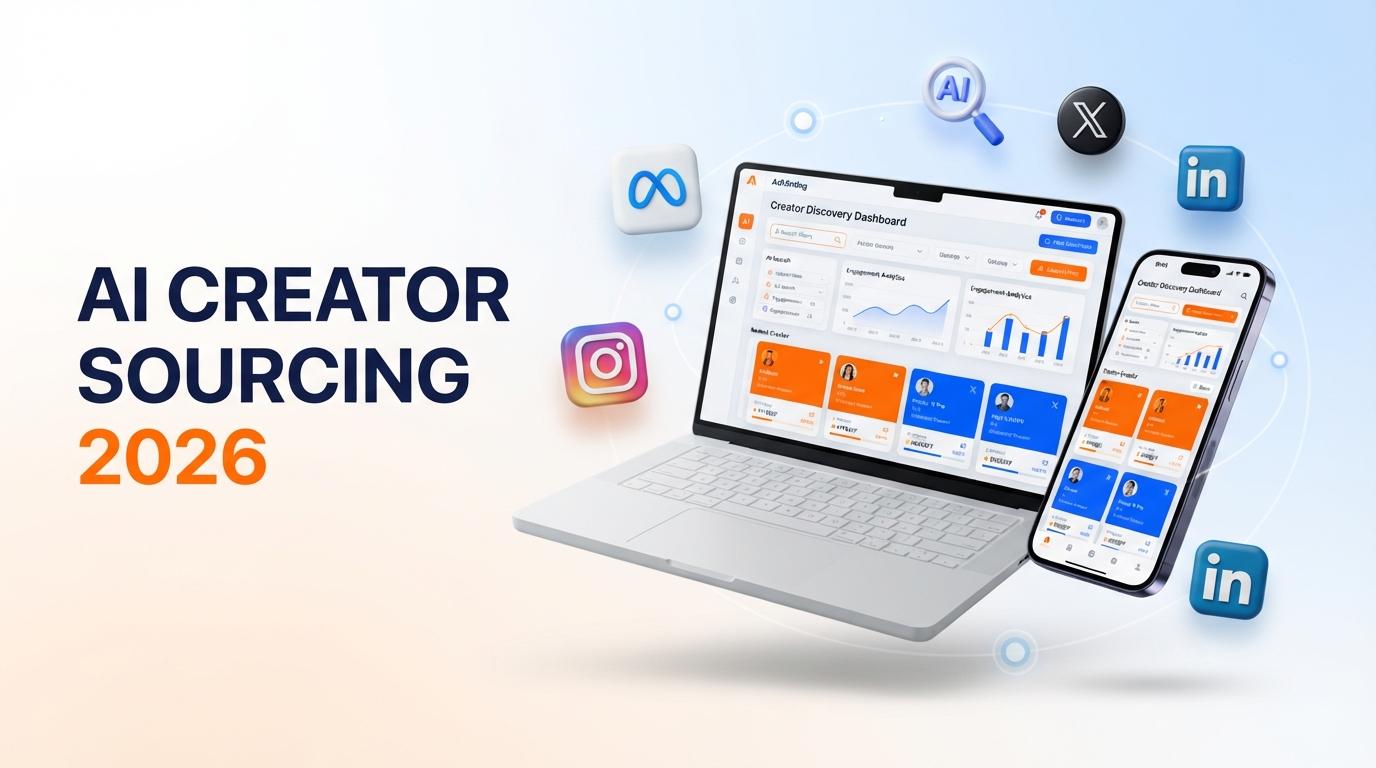
AI Creator Sourcing 2026: Strategy & Tools to Outperform

Chukwunyere Ebube
November 17, 2026
AI-Driven Creator Sourcing: Tools and Tactics to Outperform Rivals in 2026
Traditional influencer discovery is officially broken. If your marketing team is still manually scrolling through social media feeds, sifting through vanity follower metrics, and sending cold direct messages that end up in filtered request folders, you are already falling behind.
Consequently, forward-thinking digital brands across Nigeria, Africa, and global markets have shifted toward a smarter, data-backed approach: AI-driven creator sourcing.
According to recent industry benchmarking data, global influencer marketing spend is projected to surge past $32 billion, with over 73% of brand teams utilizing specialized artificial intelligence tools within their creator strategy. Meanwhile, Africa's digital creator economy is expanding rapidly, heading toward a $17.84 billion valuation.
In Nigeria alone, where over 56% of digital creators earn modest monthly returns despite high engagement, brands face a distinct challenge: identifying real, high-converting community leaders among thousands of aspiring accounts.
Let’s explore how leveraging artificial intelligence for influencer identification, vetting, and relationship management gives your brand a decisive unfair advantage in 2026.
Consider the case of a rising digital payment app launching across Lagos, Abuja, and Port Harcourt.
In early 2025, the marketing team took a traditional path, they allocated 70% of their quarterly acquisition budget to secure two well-known celebrity lifestyle creators with over 1.5 million followers each. On paper, the campaign looked promising.
Yet, after thirty days, the results were underwhelming: high brand impressions, but an abysmal conversion rate that translated to a steep Cost Per Acquisition (CPA).
Realizing a pivot was necessary, the team re-engineered their playbook using AI-driven creator discovery and community matching. Instead of chasing broad celebrity reach, they deployed algorithmic sourcing tools to identify thirty micro- and nano-creators with localized followings (between 5,000 and 35,000 followers) across specialized niches, such as tech reviewers, university campus hustle coaches, and thrift-fashion resellers.
| AI Sourcing & Match Engine | |
| 5,000 - 35,000 Targeted Micro/Nano | Verified Local Community Trust |
| Result: 310% App Downloads Increase & 58% Reduction in Acquisition CPA | |
The predictive AI engine audited these creator profiles, verifying that their followers were over 85% authentic Nigerian consumers with active financial interests. Furthermore, by executing through structured marketplace escrow systems, campaigns were launched within days.
The outcome? The campaign achieved a 310% increase in app downloads and reduced overall customer acquisition costs by 58%. The lesson is unmistakable: in 2026, targeted community trust consistently beats unverified vanity metrics.
By the end of this comprehensive guide, you will learn how to build an end-to-end, AI-powered creator sourcing engine. You will master the exact tools, data-driven vetting frameworks, and tactical workflows needed to identify hyper-relevant micro-communities, eliminate ad fraud, structure automated escrow payments, and generate maximum ROI across African and global markets.
How Do Top Digital Brands Discover High-Converting Niche Creators in 2026?
Modern brands systematically discover top-performing content partners by replacing subjective guesswork with machine learning models. Rather than filtering creators solely by geographic location or superficial follower totals, AI-driven platforms analyze semantic content patterns, audience psychographics, historical conversion data, and cross-platform engagement trust scores.
This systematic data processing allows brands to surface underground, highly engaged niche leaders who possess deep affinity with their target customer segments.
The 6 Core Pillar Tactics for AI-Driven Creator Sourcing
To outperform competitors, digital brands and agencies must upgrade their creator acquisition strategy across six operational pillars. Below is an in-depth breakdown of the What, Why, and How for each tactic.
1. Natural Language Processing (NLP) & Semantic Search
Forget traditional keyword tag searches like "#LagosFashion" or "#TechNigeria." AI-driven NLP search engines scan millions of audio transcripts, video captions, comment threads, and bio descriptions to uncover contextual relevance.
Semantic creator sourcing utilizes Natural Language Processing (NLP) to interpret the contextual meaning, sentiment, and visual themes of a creator's content library rather than relying on static bio tags.
Creators rarely describe themselves using rigid commercial keywords. A creator who regularly produces content explaining personal finance budgeting techniques on TikTok might simply label themselves a "Lifestyle Vlogger." AI semantic indexing spots these contextual signals instantly.
HOW:
- Define your ideal creator prompt using natural query language (e.g., "Find micro-creators in West Africa discussing budgeting tools, cross-border payments, or remote freelancer income").
- Use AI sourcing engines to scan historical video scripts, spoken audio, and post captions across Instagram, YouTube Shorts, and TikTok.
- Filter results based on semantic intent signals—such as positive sentiment around problem-solving—to build a qualified, highly context-relevant target roster.
2. Forensic Bot Detection & Audience Authenticity Auditing
Ad fraud, bought engagement, and inflated followings continue to drain digital marketing budgets. In response, modern AI auditing platforms analyze deep network connections to separate authentic engagement from artificial inflation.
Forensic authenticity auditing uses machine learning pattern-recognition to evaluate an influencer's audience quality, checking account creation dates, comment velocity, and follower distribution anomalies.
Research indicates that an average of 15% to 25% of social engagements across unverified open networks are driven by automated bots or engagement pods. Paying base rates on inflated reach severely erodes return on ad spend.
HOW:
- Input shortlists into AI auditing engines to calculate an Audience Authenticity Score (AAS).
- Reject profiles where non-localized or suspicious accounts exceed 15% of total reach.
- Inspect comment-to-like ratios and comment diversity; repetitive generic emojis or instant automated replies are immediate flags for automated bot activity.
3. Predictive ROI & Conversion Performance Modeling
Rather than selecting creators and hoping for positive results, predictive analytics algorithms evaluate historical campaign performance, audience buying intent, and channel benchmark data to project potential returns before a single dollar is committed.
Predictive ROI modeling uses machine learning regressions to forecast key performance metrics, including expected Click-Through Rates (CTR), Conversion Rates (CVR), and Cost Per Acquisition (CPA), for specific brand-creator pairings.
Bizkol
Removing trial-and-error uncertainty allows brand strategists to allocate media spend with confidence, directing larger capital amounts to partnerships with higher projected returns.
HOW:
- Aggregate past campaign performance data, including creative formats, product price points, and target demographics.
- Run AI predictive simulations comparing creator profiles against baseline conversion metrics.
- Prioritize creators whose audience profiles exhibit high commercial intent signals, such as frequent interactions with shopping links and product recommendation posts.
4. Hyper-Niche & Micro-Community Discovery
In 2026, audience size is secondary to community density. Micro-creators (5,000 to 50,000 followers) and nano-creators (1,000 to 5,000 followers) regularly generate engagement rates up to 4x higher than macro-influencers due to deep personal trust with their followers.
| INFLUENCER TIER PERFORMANCE COMPARISON (2026) | |||
|---|---|---|---|
| INFLUENCER TIER | AVERAGE FOLLOWERS | AVG. ENGAGEMENT RATE | PRIMARY CAMPAIGN ROLE |
| Nano-Creator | 1,000 - 5,000 | 4.5% - 8.0% | High-Trust Direct Conversion |
| Micro-Creator | 5,000 - 50,000 | 2.5% - 4.5% | Hyper-Targeted Niche Growth |
| Mid-Tier Creator | 50,000 - 500,000 | 1.5% - 2.5% | Balanced Reach & Consideration |
| Macro / Celebrity | 500,000+ | 0.5% - 1.2% | Broad Mass Brand Awareness |
Niche discovery relies on AI clustering algorithms to group digital creators by shared micro-interests, sub-cultures, or localized geographic hubs.
Audiences treat micro-influencers as trusted peers. When a micro-creator with an active niche following recommends a service, their recommendation functions like a direct word-of-mouth referral.
HOW:
- Leverage structured creator platforms like the Adminting Creator Network to connect directly with niche digital promoters without middleman friction.
- Deploy creator portfolios across multiple sub-niches rather than relying on a single large account.
- Structure recurring ambassador-style collaborations with top-performing micro-creators to build long-term brand equity and conversion consistency.
5. AI-Assisted Outreach & Automated Negotiation
Reaching out to creators individually via manual email or direct messaging creates significant operational bottlenecks. AI-assisted messaging sequences optimize response rates while scaling creator onboarding seamlessly.
Dynamic communication automation uses customized AI models to craft personalized, brief-aligned outreach messages and manage campaign negotiations at scale.
Slow communication cycles and unclear campaign requirements cause high churn rates among quality creators. Streamlined workflows keep creators engaged and focused on content execution.
HOW:
- Generate clear, structured campaign briefs specifying deliverables, usage rights, and timelines.
- AdMinting
- Implement automated messaging systems that customize outreach emails based on a creator's recent work and specific content style.
- Establish structured performance tiers, offering base compensation combined with performance incentives for conversions driven through unique tracking links.
- AdMinting
6. Escrow-Protected Campaign Execution & Direct Payout Systems
Payment friction and security concerns remain major operational challenges in emerging markets. Establishing transparent, automated escrow infrastructure protects both advertisers and content partners throughout campaign execution.
Automated escrow campaign management locks committed advertising funds in secure accounts, releasing payouts automatically once verified deliverables meet brief criteria.
AdMinting
Escrow safeguards brand capital against non-delivery or incomplete work while guaranteeing prompt payment to creators, establishing trust across both sides of the partnership.
AdMinting
HOW:
- Run campaigns through integrated platforms like Adminting Marketplace, where funds are safely deposited into escrow prior to project kickoff.
- Define objective performance milestones—such as brief approval, content publishing, and tracking verification.
- Automate final payout disbursements within 72 hours of successful milestone completion.
- AdMinting
How Do Brands Calculate True ROI on Micro-Influencer Campaigns in Emerging Markets?
Measuring campaign impact in dynamic markets like Nigeria requires looking beyond surface-level impression metrics. To capture true return on investment, brands should deploy a multi-touch attribution model incorporating both direct sales metrics and downstream brand signals.
| MULTI-TOUCH ATTRIBUTION MODEL | |
|---|---|
| [ Campaign Launch ] | Track Unique Referral Links & Discount Codes |
| [ Direct Conversions ] | Revenue Driven / Total Campaign Spend = Direct ROI |
[ Brand Equity Amplification ]
|
|
- Direct Attribution: Assign every creator a unique tracking link and custom promo code. Calculate direct Return on Ad Spend (ROAS) using total revenue generated relative to campaign budget.
- Cost-per-Acquisition (CPA) Comparison: Measure the total cost to acquire a customer via creator campaigns against traditional paid digital ad channels.
- Content Reusability Value: Factor in licensing savings achieved by repurposing authentic User-Generated Content (UGC) across owned paid channels and social storefronts.
- Organic Search & Brand Lift: Track spikes in direct search traffic and branded keyword queries occurring alongside creator campaign rollouts.
Conclusion
As the creator economy expands across Nigeria, Africa, and global digital markets, relying on manual outreach and surface-level follower counts is no longer viable. The brands dominating their categories in 2026 are those using artificial intelligence to discover, vet, and manage creator networks with precision.
By combining natural language discovery, automated audience auditing, predictive performance analytics, and escrow-backed campaign workflows, your business can build high-performing creator engines that consistently generate measurable return on investment.
Are you ready to stop guessing and start scaling high-converting creator campaigns?
Visit Adminting.com today. Connect with our verified network of niche digital promoters, access real-time performance analytics, and launch targeted campaigns secured by automated escrow protections.
FAQ
Q1: Why are micro- and nano-influencers delivering better ROI than celebrity creators in 2026?
Micro- and nano-creators build close, personal relationships with dedicated niche audiences. Consequently, their content yields significantly higher engagement and trust, reading like a personal recommendation rather than a broadcast ad. Combined with lower cost points, this enables brands to diversify campaign risk and achieve lower overall Customer Acquisition Costs (CPA).
Q2: How does AI creator sourcing detect fake followers and engagement pods?
AI systems analyze underlying account behavioral metrics. They evaluate account creation timelines, follower growth curves, comment diversity, and interaction speeds. Sudden artificial follower spikes or repetitive, automated comment patterns trigger instant flags, allowing brands to filter out compromised accounts before allocating spend.
Q3: Is AI-driven sourcing suitable for small businesses with modest budgets?
Yes. AI-driven platforms like Adminting democratize access to creator marketing. Small businesses can specify exact budget limits, target hyper-local audiences, and partner with qualified micro-promoters without requiring large upfront agency retainers.
Q4: How long does it take to launch an AI-curated campaign on Adminting?
While traditional agency sourcing typically takes weeks, AI-assisted candidate shortlisting and campaign creation can be completed in minutes. Once your campaign brief is live on the marketplace, verified creators can join, accept briefs, and begin producing content almost immediately.
Reference
- Adminting Ltd. (2026). Niche Advertising Platform & Creator Network Ecosystem. Adminting Official Marketplace & Adminting Blog Portal.
- Bizkol AI Research. (2026). 55 Influencer Marketing Statistics for 2026 (Backed by Global Data). Bizkol Insights.
- CreatorIQ. (2026). The State of Creator Marketing Trends 2025–2026 Report. CreatorIQ Intelligence.
- Stonehill Research & Business Cardinal. (2026). Nigeria & Africa Creator Economy Market Value & Growth Outlook 2026. Nigeria Creator Economy Report.
- Influee Insights. (2026). Influencer Marketing Trends: How Micro-Influencers and UGC Drive Enterprise Conversions. Influee Blog.
Recommendation
To further optimize your digital marketing and growth strategy, explore these related guides from our platform:
- Unlocking Niche Audiences: How to run high-impact campaigns across hyper-local digital communities without overspending.
- Creator Monetization Playbook: How modern African creators are building sustainable income streams through direct brand partnerships.
- Escrow & Campaign Security: Why transparent tracking and goal-based payment models are revolutionizing digital advertising.