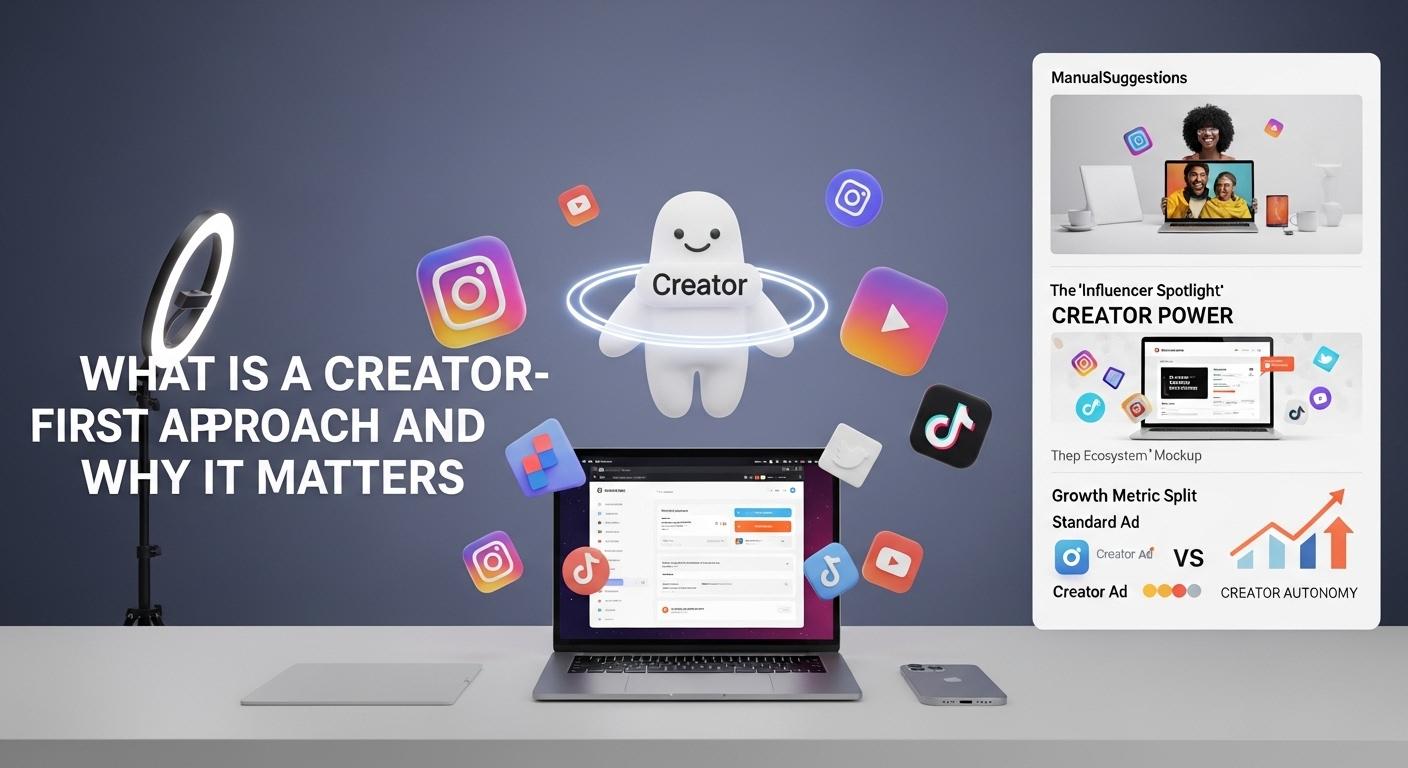
What Is a Creator-First Approach and Why It Matters

Chukwunyere Ebube
April 24, 2026
What Is a Creator-First Approach and Why It Matters
Here is a question worth sitting with: when a brand approaches a content creator, who is actually in the driver's seat? If you study most traditional brand-influencer deals, the honest answer is the brand. The brand controls the brief, the messaging, the approval process, and, quite often, the tone of voice. The creator is essentially a human billboard paid to broadcast a message that was written by someone who has probably never met their audience.
Now consider this: consumer trust in influencers has climbed to 67% in 2026, up from 61% just a year ago, according to Amra and Elma Research. Meanwhile, 94% of Gen Z consumers say they trust influencers more than they trust traditional advertisements. These are not small numbers. They represent a fundamental shift in where credibility lives and it is living with creators, not corporations.
Yet many brands are still running their creator partnerships the old way, rigid scripts, tight approval loops, and a deep reluctance to let go of control. The result is content that audiences see through immediately, polished, corporate-feeling posts that sit awkwardly inside a feed full of authentic, personal storytelling. The content underperforms, the brand is puzzled, and the creator's reputation takes a quiet hit.
There is a better way, and it has a name: a creator-first approach. This post is going to explain exactly what that means, why it is becoming the defining philosophy of successful brand-creator partnerships in 2026, how it plays out in practice for brands and platforms alike, and why it is especially relevant for brands and creators operating in Nigeria and across Africa's fast-growing digital economy.
Let us talk about Bose, the global audio brand, because their story is one of the most instructive case studies in creator-first thinking available today.
A few years ago, Bose partnered with Chris Brickley, an NBA skills trainer with millions of loyal followers who genuinely used and loved Bose products. The partnership could have gone the way of most brand deals, a polished, scripted video, a few branded talking points, and a tracked link in the bio. Instead, Bose gave Brickley something most brands are terrified to give creators: real creative latitude. They let him show up as himself. They let his relationship with the products feel like part of his life, not an interruption to it.
At the ARF Creative Effectiveness 2025 event, Bose's team reflected on what made those partnerships work. The answer, as reported by CommPRO, was deceptively simple: "The partnerships that last are the ones that feel natural." Brickley himself described the experience as sharing a lifestyle that fans recognise as genuine. The outcome? Stronger emotional bonds between Bose's brand and an audience that had never seen the products advertised to them — they had seen them lived with.
That is what a creator-first approach looks like in practice. And that is exactly the standard that brands in Nigeria and across Africa need to aspire to as their own creator economy matures.
By the end of this post, you will know exactly:
- What a creator-first approach is and how it differs from traditional brand-led partnerships
- The concrete evidence that it produces better results for both brands and creators
- How to apply creator-first thinking whether you are a brand, a platform, or a creator yourself
- Why this philosophy is particularly powerful and urgently needed in the Nigerian and African digital marketing space
So what exactly is a creator-first approach, and why does the way a brand treats its creator partners have such a measurable impact on campaign outcomes?
What a Creator-First Approach Actually Means
A creator-first approach is a philosophy and a set of practical behaviours that places the creative autonomy, professional respect, and long-term success of content creators at the centre of how brands, platforms, and agencies design their partnerships.
The key word here is "centre." A creator-first approach is not simply about being nice to creators, or paying them a fair rate, or saying you value their work. It is about structurally redesigning how partnerships are conceived, briefed, and executed so that the creator's authentic voice, the very thing their audience trusts is protected and amplified rather than overwritten.
To understand what this means in practice, it helps to understand what a creator-first approach stands in contrast to. The opposite is a brand-first approach, in which the brand's messaging needs, visual guidelines, legal compliance requirements, and approval preferences are the primary organising principle of the partnership. In a brand-first model, the creator is a distribution channel, their job is to put a pre-approved message in front of their audience as efficiently as possible. In a creator-first model, the creator is a co-author, their job is to bring a brand idea to life in a way that feels native to their voice, their platform, and their community.

The Three Pillars of a Creator-First Approach
Understanding this philosophy requires breaking it down into three distinct but interlocking pillars that together define what it genuinely means to be creator-first.
Creative freedom within clear boundaries
A creator-first approach does not mean a brand abandons its identity or abdicates all control. What it does mean is that the brand communicates its objectives, non-negotiables, and brand values and then trusts the creator to decide how to bring those to life for their specific audience. Think of it as providing the "why" and the "what," while letting the creator own the "how." Google's Creator Partnerships Hub, unveiled in 2025, puts it plainly: "Authenticity is the asset you're leveraging." When a partnership is executed well, audiences do not feel the friction between an advertisement and a piece of trusted creator content, it simply feels like a recommendation from someone they know.
Fair and transparent compensation
A creator-first philosophy is also an economic stance. It argues that creators deserve to be paid fairly, promptly, and in ways that reflect the actual commercial value their content generates. This includes moving beyond flat-fee, pay-per-post structures toward models that share in performance outcomes — affiliate commissions, revenue splits, performance bonuses, so that creators benefit when their work drives real results. Agencies and platforms that embrace creator-first values have started building payment guarantees into their model. Exif Media, for instance, reports that paying creators within 15 days of content delivery regardless of when the brand pays them has become one of their strongest competitive advantages, because creator trust is not abstract; it shows up in the quality and enthusiasm of the content they receive back.
Long-term partnership over transactional deals
Perhaps the most commercially powerful dimension of a creator-first approach is the move away from one-off, campaign-by-campaign transactions toward sustained, relationship-based collaborations. The data on this point is remarkably clear: according to Connect Management's research, brands that commit to creator relationships of 12 months or longer report approximately 300% higher engagement rates and up to 4x better conversion rates compared to short-term campaigns. Content creation costs also drop by as much as 40-60% over time as the brand and creator develop shared vocabulary, trust, and creative rhythm. This is not incremental improvement, it is a structural advantage.
The Business Case: Why Creator-First Delivers Better Results
Let us address the most important question a brand marketing team will ask about any philosophical shift in how they do business: does it actually work? The answer, backed by data from across the industry, is an emphatic yes.
📊 Campaigns where creators had creative freedom delivered 2.4× higher engagement than campaigns with rigid, script-based briefs. — Exif Media, 2026
Exif Media's data — drawn from over 2,080 campaigns, shows that creative freedom is not a soft benefit; it is a quantifiable performance multiplier. The mechanism behind this is straightforward: audiences follow creators because they trust their taste and judgment. The moment a creator's content starts to feel scripted or inauthentic, that trust erodes, and with it goes the attention and purchasing intent that made the creator valuable to the brand in the first place.
The ROI Case for Long-Term Creator Partnerships
Beyond single-campaign metrics, the ROI case for creator-first, long-term partnerships is compelling for any brand serious about building sustainable creator-led growth.
According to research compiled by Connect Management and Viral Nation, long-term creator partnerships consistently deliver 3.8x better ROI than transactional relationships. The compounding mechanism works like this: in a one-off campaign, the creator's audience encounters the brand once, in the context of a clearly sponsored post. In a long-term partnership, they encounter the brand repeatedly, across multiple content formats, in ways that feel increasingly organic. The brand gradually becomes part of the creator's world in the audience's mental model and that is an extraordinarily powerful position to hold.
The State of Creator Marketing Report 2025-2026 by CreatorIQ, which surveyed 1,723 brands, agencies, and creators, found that average annual influencer marketing budgets have grown by 171% year-over-year, with 71% of organisations increasing investment. Crucially, the report notes that nearly two-thirds of this new spend is being reallocated from traditional paid and digital channels. Brands are not just experimenting with creator partnerships anymore, they are making them the engine of their marketing mix. A creator-first approach is the philosophy that makes that engine run cleanly.
Trust Is the Product
One of the most important insights shaping creator marketing in 2026 is that consumer trust not reach, not follower count, not CPM is the ultimate marketing asset. According to Ringly.io's 2026 influencer statistics, 77% of Gen Z consumers have made a purchase based on an influencer's recommendation. Purchase intent from trusted influencer content reached 71% in 2026. These numbers reflect not just attention but action which is exactly what brands need from their marketing spend.
A creator-first approach is, at its heart, a trust-preservation strategy. When brands give creators the freedom to show up authentically, they are not just being generous they are protecting the very asset that makes the partnership commercially valuable. Brands that understand this are the ones building sustainable, high-performing creator programs in 2026.
Creator-First for Platforms: What It Means Beyond Brand Partnerships
So far, we have focused on how brands can apply a creator-first approach to their influencer partnerships. But this philosophy also has deep implications for the platforms and marketplaces that sit between creators and brands.
A platform that is genuinely creator-first asks a very different set of design questions than one that is optimised primarily for its own revenue or for brand convenience. A creator-first platform asks: Do creators have transparent access to their own audience data? Are the revenue-sharing terms predictable and fair? Does the platform give creators tools to build direct relationships with their fans, so they are not entirely dependent on an algorithm? Are policy changes communicated with adequate notice and creator input?
These questions matter enormously in the African context, because for years Nigerian and other African creators were structurally disadvantaged by platforms that were not designed with their realities in mind. International payment rails excluded them. Geographic restrictions prevented them from accessing monetisation features available to creators in North America or Europe. Audience data remained locked behind platform walls. A creator-first platform approach addresses these structural inequities directly and the platforms doing this work in Africa are the ones attracting the most talented creators.
The Nigerian Creator Economy and the Creator-First Imperative
Africa's creator economy is at a pivotal moment. According to Afrikan Insights (2026), the African creator economy was valued at approximately $5.1 billion in 2025 and is projected to reach nearly $29.8 billion by 2032, growing at around 28.7% annually. Influencer spending across the continent is rising by roughly 25% per year as marketers shift budgets away from traditional channels.
Within this broad African expansion, Nigeria is the epicentre of creator culture and creator commerce. Nigerian creators have driven global cultural moments, Afrobeats, Nollywood, digital comedy, beauty and fashion content while historically capturing very little of the economic value their creativity generated. A creator-first approach applied to the Nigerian market is not merely a business strategy. It is, in many respects, a corrective to a long history of creative extraction where the culture was exported but the compensation stayed behind.
📊 Influencer campaigns targeting Nigerian audiences in local languages saw brand recall increase by 9.6%. Local creators, local language, creator-first strategy. — Nex Media, 2025
This data point from a YouTube campaign that produced content in Hausa, Yoruba, Pidgin, Igbo, and English simultaneously is more than a language lesson. It is a creator-first lesson. It demonstrates that when you allow creators to communicate in the voice and language their audience actually uses rather than imposing a standardised, brand-approved message, the results are dramatically better. That is creator-first philosophy in action.
According to a 2026 report by African Business Innovation referencing Penquin agency, the most successful campaigns in Africa in 2026 are those where brands trust creators to do what they do best. When creators are given the space to tell brand stories in their own voice, the content performs better because it does not feel forced or overly scripted. The message for brands entering or growing in the Nigerian market could not be clearer: authentic, creator-led storytelling is the competitive advantage.
But What If Your Brand Needs Control Over Its Messaging?
This is the most common objection to a creator-first approach, and it deserves a direct, honest answer. Yes, there are categories of content where brands genuinely cannot give creators full creative latitude, regulated industries like pharmaceuticals, financial services, or alcohol require specific legal disclaimers and compliance language. Brand safety concerns are real, especially for large organisations with significant reputational exposure. These constraints are valid.
The key insight, however, is that creative freedom and brand safety are not opposites. They exist on a spectrum, and the job of a creator-first brand strategy is to find the right point on that spectrum for each partnership. Nicholas Spiro, Chief Commercial Officer at Viral Nation, describes this balance well. Speaking to Net Influencer (2025), he identified the biggest mistake CMOs make with creator partnerships as "the combination of fear and control." His advice? "The best brands learn to give up a little control and let creators be creative." The phrase "a little control" is instructive not all control, but enough to let the creator's authentic voice breathe.
Tools like AI-powered content moderation, frame-by-frame video analysis, and detailed pre-campaign briefing documents can give brands meaningful confidence about brand safety without requiring them to script every word a creator says. The technology now exists to protect brands while respecting creators. A creator-first approach does not require naivety about risk, it requires sophistication about how risk is managed without stifling creativity.
How Adminting Applies Creator-First Thinking
At Adminting, the creator-first approach is not a philosophy we arrived at by reading industry reports, though the data certainly confirms it. It is the foundational logic of how we built our platform and how we think about the relationship between advertisers and promoters.
We believe that the creator's voice, community, and creative intelligence are the product, not a vehicle for delivering someone else's product. That means we design our campaign structures to give creators the context and objectives they need to succeed, while preserving the creative space they need to communicate authentically with their audience.
For brands and businesses on Adminting, this approach delivers better content, higher engagement, stronger audience trust, and more durable campaign results. For creators and influencers on our platform, it means being treated as the skilled professionals you are, fairly compensated, clearly briefed, and given the creative room to do your best work.
Whether you are a brand looking to connect with the right creative voices in Nigeria and across Africa, or a creator ready to build partnerships that respect your craft and reward your results, Adminting is built for exactly this moment in the creator economy.
Conclusion
The creator economy is not slowing down. The global influencer marketing industry reached $32.55 billion in 2025 and is on track to exceed $40 billion in 2026, according to Mordor Intelligence data compiled by Ringly.io. As AI-generated content floods every platform, audiences are becoming more discerning, not less. They are gravitating toward creators they trust, and they are buying from brands those creators genuinely endorse. In this environment, a creator-first approach is not idealism, it is the clearest commercial strategy available.
We have covered a lot of ground in this post. We explored what a creator-first approach actually means across its three pillars: creative freedom, fair compensation, and long-term partnership. We examined the data showing that creator-first campaigns deliver 2.4x higher engagement, 3.8x better long-term ROI, and 300% higher engagement in sustained relationships. We looked at how the philosophy applies to platforms and marketplaces, not just brands. And we grounded all of it in the Nigerian and African context, a creator economy growing at 28.7% annually, where cultural authenticity and linguistic specificity are proven performance drivers.
The brands and platforms that will win the next decade of the creator economy are not the ones with the biggest budgets or the most followers. They are the ones that genuinely respect creators, their craft, their communities, their creative intelligence, and their right to be fairly rewarded for the value they generate. That is what a creator-first approach delivers. And in 2026's crowded, fast-moving digital landscape, it is the only approach that makes lasting sense.
Visit Adminting.com today to take your place in the creator economy's next chapter. Sign up as an advertiser to connect your brand with authentic, engaged creators across Nigeria and Africa or join as a promoter to build brand partnerships that respect your voice and reward your work. Start today at adminting.com.
FAQ
Q1: What is a creator-first approach in simple terms?
A creator-first approach means designing brand-creator partnerships so that the creator's authentic voice, creative judgment, and professional wellbeing are central to how the collaboration is structured — rather than treating the creator as a passive channel for delivering a pre-written brand message. In practice, it means clearer but less restrictive briefs, fairer compensation, longer-term relationships, and genuine creative collaboration.
Q2: Does giving creators creative freedom mean brands lose control of their message?
Not at all. A creator-first approach draws a clear distinction between brand safety (protecting a brand's legal, ethical, and reputational boundaries) and creative control (dictating exactly how a creator must communicate). Brands can — and should — set firm parameters around what is off-limits. Within those parameters, however, the most effective campaigns give creators the freedom to tell the brand's story in a way that feels native to their voice and platform. The data consistently shows that this produces better results than rigid scripting.
Q3: Is a creator-first approach more expensive for brands?
In the short term, creator-first partnerships — which prioritise fair compensation and long-term relationships — may involve higher initial investment than transactional, one-off deals. However, research shows that long-term creator partnerships reduce content production costs by 40-60% over time, while delivering up to 4x better conversion rates and 3.8x higher ROI. Brands should think of creator-first investment as building an asset, not running an expense.
Q4: How does a creator-first approach apply specifically to African and Nigerian brands?
For brands operating in Nigeria and Africa, a creator-first approach is especially powerful because of the continent's extraordinary linguistic and cultural diversity. Audiences in Nigeria respond far more strongly to content produced in their own language and cultural register — Yoruba, Igbo, Hausa, Pidgin — than to standardised, globally templated messaging. Creator-first partnerships that give African creators the freedom to communicate in culturally authentic ways consistently outperform those that impose global brand standards without local adaptation.
Q5: How can a small brand adopt a creator-first approach on a limited budget?
A creator-first approach is actually more accessible for smaller brands than many assume, because it pairs naturally with nano and micro-influencer strategies — which are among the most cost-effective forms of creator marketing available. Rather than spending a large budget on a single celebrity partnership, a small brand can build creator-first relationships with five to ten nano-creators in their specific niche, giving each of them genuine creative freedom, fair compensation, and a long-term collaboration commitment. The engagement rates and community trust built through this model typically far exceed what a bigger-budget, brand-first celebrity campaign would deliver.
References
- CreatorIQ — State of Creator Marketing Report 2025-2026
- Influencer Marketing Hub — Influencer Marketing Benchmark Report 2026
- Exif Media — Creator-First vs. Brand-First Agencies: Why Loyalty Matters (Jan 2026)
- Viral Nation — What Creators Really Want From Brands In 2025 (Oct 2025)
- CommPRO — How Bose Turns Authentic Creator Partnerships Into Brand Power (Oct 2025)
- Connect Management — How to Build Long-Term Relationships Between Brands and Creators (Dec 2025)
- Ringly.io — 47 Influencer Marketing Statistics for 2026
- Afrikan Insights — Africa's Creator Economy and Influence Commerce Is Maturing Fast (Jan 2026)
- African Business Innovation — Why Influencer Marketing Budgets Are Shifting Back to Authentic Creator-Led Content (Apr 2026)
- Nex Media — Why Africa's Creator Economy Is the Next Global Marketing Frontier (May 2025)
- Net Influencer — Viral Nation's Nicholas Spiro Reveals How Psychology, AI, and Brand Safety Enable Creator Freedom (Oct 2025)
- Impact.com — Influencer Marketing Trends 2026: Performance Insights (Jan 2026)
Recommended Reading & Next Steps
If this post gave you a new lens on creator partnerships, here are the next topics and resources we recommend exploring — all directly connected to the creator-first philosophy in practice.
- The Future of Creator Marketplaces in the Creator Economy — Our previous post on how creator marketplaces are building the infrastructure that makes creator-first partnerships possible at scale. Read it on the Adminting blog.
- How Micro-Influencers Are Driving Better ROI for Brands in Nigeria — A deep dive into why smaller creators with highly engaged audiences consistently outperform macro-influencers in performance-focused campaigns.
- Social Commerce in Africa: The Next Frontier for Creator Monetisation — How TikTok Shop, Instagram Live selling, and WhatsApp commerce are enabling creator-first commerce models across the continent.
- Building Your Creator Profile on Adminting: A Practical Guide for Nigerian Creators — Everything you need to know to position yourself professionally and attract the right brand partnerships.
- Adminting's full resource hub at adminting.com — Ongoing guides, case studies, and insights for brands and creators navigating the African digital marketing landscape.
Ready to put creator-first thinking into action? Visit Adminting.com and sign up today — as an advertiser ready to run smarter, more authentic campaigns, or as a promoter ready to build partnerships that respect your craft and grow your income. The creator economy's next chapter is being written right now.