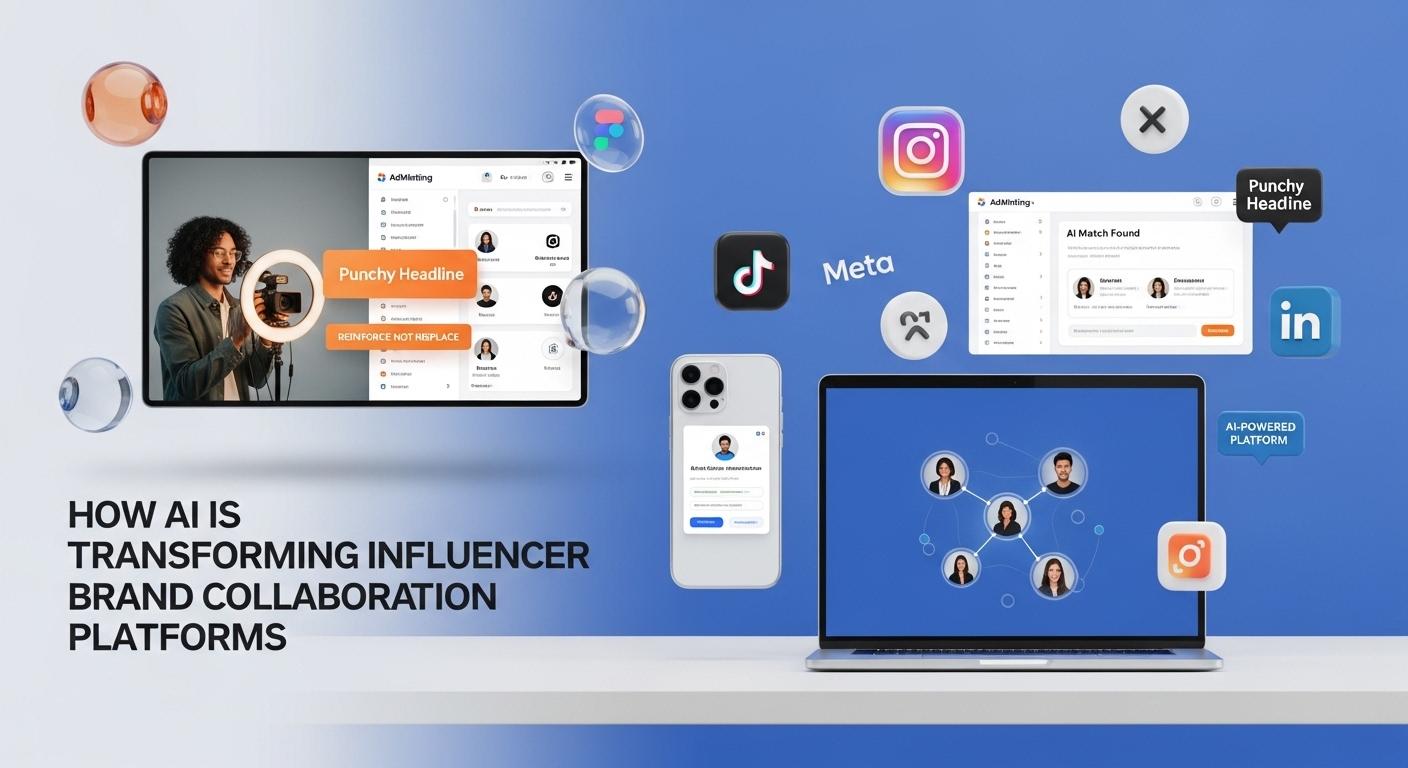
How AI Is Transforming Influencer Brand Collaboration Platforms

Chukwunyere Ebube
April 25, 2026
How AI Is Transforming Influencer Brand Collaboration Platforms
Not long ago, a brand manager who wanted to run an influencer campaign had to do all of it by hand. They would scroll through Instagram for hours, DM creators one by one, exchange briefs through WhatsApp, track deliverables in a spreadsheet, and squint at vanity metrics, follower counts, likes, impressions trying to convince themselves that the campaign was working. If an influencer had bought half their followers, there was no easy way to know. If a campaign post was going viral in the wrong direction, no alert would go off. The whole process was exhausting, slow, and expensive and brands did it this way for years because there was simply no better option.
Artificial intelligence has changed that completely. In 2026, AI is not a bonus feature on the best influencer collaboration platforms, it is the engine underneath everything. It is what powers smarter creator discovery, real-time fraud detection, predictive campaign performance, automated outreach, content analysis, and social commerce attribution. According to the Influencer Marketing Hub's 2026 Benchmark Report, only 10.56% of marketers say they are not using AI in their influencer operations. That means nearly nine in ten marketing professionals are already integrating machine learning into how they find, vet, manage, and measure creator partnerships.
And the financial stakes make this transformation urgent. The global influencer marketing industry is now valued at $38.7 billion, according to revised joint projections by Statista and Goldman Sachs surpassing earlier forecasts by 18.9%. Fraud alone is consuming an estimated $4.8 billion of that spend annually in wasted, misallocated budget.
Meanwhile, the best AI-enabled campaigns are generating returns of $18 to $20 for every dollar invested, more than triple the already-impressive industry average of $5.78 per dollar. The gap between brands using AI well and brands that are not is no longer academic. It is a measurable competitive advantage.
In this post, we are going to walk through exactly how AI is transforming influencer brand collaboration platforms, function by function, layer by layer. We will look at the specific ways machine learning is changing creator discovery, fraud detection, content analysis, campaign measurement, payment infrastructure, and social commerce integration. We will connect all of it to the Nigerian and African market, where AI presents not just efficiency gains but a genuine opportunity to level the playing field for brands and creators who have historically been underserved by global platform technology. And we will show you how Adminting is building these principles into the platform it is developing for the African creator economy.
What Changes When AI Enters the Room
Let us use a concrete example to make this real. A mid-sized fashion brand in Lagos decided in early 2025 to run an influencer campaign targeting Nigerian women aged 18 to 30 across Instagram and TikTok. Without AI tools, their marketing manager spent three weeks manually searching for creators, reviewing profiles, negotiating fees, and assembling a roster of twelve influencers who looked right on paper.
Three weeks into the campaign, performance was disappointing. Engagement was thin, conversions were nearly zero, and when they ran a post-campaign audit using a basic AI fraud detection tool, they discovered that three of the twelve influencers they had paid had follower bases that were between 30% and 45% fake. One creator's comment section was dominated by bot accounts leaving generic responses within minutes of each post going live — a telltale sign that the tool's pattern recognition had flagged immediately but that no human reviewer had caught. The campaign wasted approximately 25% of its total budget on partnerships that delivered nothing real.
Now contrast that with what a platform equipped with AI-powered creator matching, audience authenticity scoring, and real-time engagement analysis would have delivered. Creators with suspicious follower patterns would have been flagged before any budget was committed. Audience demographic overlap would have been mapped so the brand was not paying three different influencers to reach the same 15,000 people.
Performance predictions based on historical data from similar campaigns would have set realistic benchmarks. And mid-campaign alerts would have flagged underperforming content early enough to pivot. That is the difference AI makes not marginal improvement, but structural transformation.
By the end of this post, you will understand the six core ways AI is transforming influencer brand collaboration platforms in 2026, how each transformation affects both brands and creators in practical, measurable ways, what the specific implications are for Nigerian and African brands operating in the creator economy, and how platforms like Adminting are incorporating AI principles to serve this market better.
So how exactly is artificial intelligence changing the way brands and creators find each other, work together, and prove that the work was worth it and what does this transformation mean for the African market specifically?

The Six Ways AI Is Transforming Influencer Brand Collaboration Platforms
1. AI-Powered Creator Discovery: From Keyword Search to Contextual Intelligence
The oldest problem in influencer marketing is finding the right creator. For years, the solution was essentially a glorified search engine, you typed a keyword, filtered by follower count, and hoped the results matched your needs. The problem with this approach is that follower count and surface-level keyword tags tell you very little about whether a creator's audience will actually respond to your product.
AI-powered creator discovery changes this at a fundamental level. Modern platforms use machine learning models that analyse thousands of data points simultaneously, audience demographics, content tone and sentiment, posting frequency, engagement quality, historical brand affinity, niche specificity, and cross-platform consistency, to surface creators who are not just broadly relevant but contextually aligned with a specific campaign goal.
CreatorIQ's "content first" approach illustrates how sophisticated this has become. Their AI goes beyond keywords to examine discrete parts of creator content including images, locations, mentions, and even emojis, making logical inferences from visual context. If a video shows someone drinking a beverage by a pool, that scene becomes a searchable, categorisable signal without any manual tagging. The result, as described by Favikon's 2026 platform analysis, is "astoundingly relevant influencer matches" that a keyword-based system would never surface.
For brands in Nigeria and across Africa, AI-powered discovery is particularly transformative because it can navigate the continent's extraordinary linguistic and cultural diversity in ways that manual search simply cannot. A brand running a campaign across Lagos, Accra, Nairobi, and Johannesburg simultaneously needs creators whose content resonates specifically with each city's culture, not just a generic "African" creator. AI systems that analyse content sentiment, language patterns, and local cultural references can make these distinctions accurately at scale.
📊 48% of marketers identify influencer discovery as their biggest operational challenge in 2026 — yet 60.2% are now actively using AI to solve it. — Archive Budget Allocation Report / Influencer Marketing Hub, 2026
According to research from Socially In's 2026 influencer statistics synthesis, AI is primarily deployed by brands for identifying better-fit creators through automated filtering and predicting top-performing content based on real-time signals. Natural language search tools, where a marketer types "fitness creators in Lagos with high engagement in the 25-35 female demographic" and receives a curated, data-backed shortlist within seconds are rapidly becoming the standard rather than the exception on advanced platforms.
2. AI-Driven Fraud Detection: Protecting Brand Budgets at Billion-Dollar Scale
Influencer fraud has evolved from a nuisance into a genuine crisis. According to a 2026 global audit by HypeAuditor spanning 8.7 million influencer profiles across twelve platforms, fraudulent account activity has climbed to 41.3%, with AI-generated bot networks now accounting for 58% of all detected fraud cases, a 34% increase from the 2025 baseline. The total cost to the global influencer marketing ecosystem is estimated at $4.1 to $4.8 billion in wasted annual spend.
This is not a problem that human reviewers can solve at scale. A marketing manager vetting twelve creators manually as our Lagos fashion brand did, has no realistic way to detect sophisticated bot networks, coordinated engagement pods, follow-unfollow schemes, or AI-generated synthetic influencer profiles. A Kantar and IZEA joint study tracking 3,800 brand managers in 2026 found that one in three brands admitted they had unknowingly paid a fully AI-fabricated influencer persona at least once in the past year.
AI fraud detection works by treating an influencer profile as a dataset rather than a public face. The most advanced systems analyse follower growth velocity (organic growth has friction, it climbs, plateaus, dips, then climbs again; fake growth appears as sudden, clean spikes), engagement decay rates, comment sentiment depth (real comments mention specific details; bot comments say "Nice pic!" regardless of content), audience demographic distribution consistency, cross-platform account behaviour, and temporal engagement patterns (if all 100 comments on a post arrive between 2:00 AM and 3:00 AM, they are almost certainly automated).
HypeAuditor's AI system uses 53 distinct behavioural patterns to identify fake followers, achieving industry-leading fraud detection accuracy. The platform flagged one campaign in which a fashion brand discovered that 25% of a prospective influencer's followers were bots through API-driven demographic verification, saving over $500,000 in projected wasted spend, according to Phyllo's social intelligence research.
Meanwhile, platforms like Influencity deploy multi-layer AI verification that flags sudden follower spikes, abnormal engagement ratios, and rapid declines that indicate manipulation, feeding this intelligence directly into campaign management workflows so brands never have to check fraud reports manually.
🚨 Brands that failed to verify influencer authenticity lost an average of $18,500 per fraudulent campaign. AI-powered verification reduces this risk by catching approximately 92% of obvious fraud before budget is committed. — HubSpot 2025 / Influencer Marketing Hub 2026
For the Nigerian and African market, AI fraud detection is especially critical. As the Contemeleon 2026 State of the Creator Economy in Africa report noted in our previous blog series, approximately 15% to 30% of an influencer's followers on some accounts are estimated to be bots, and fake followers cost brands $1.3 billion annually across African markets alone.
Platforms that bring AI-powered audience verification to African creator profiles are not just improving campaign efficiency; they are building the trust infrastructure that the continent's creator economy needs to mature.
3. AI Content Analysis and Brand Safety: Beyond the Post, Into the Pattern
Brand safety in influencer marketing has historically meant doing a quick scan of a creator's recent posts before signing a deal. If nothing obviously controversial appeared on the first scroll, brands typically proceeded. This is, to put it plainly, not good enough in 2026 and AI is making a more thorough approach scalable for the first time.
Modern AI content analysis systems do not just scan recent posts. They build comprehensive content profiles across a creator's entire publishing history, examining image content, caption sentiment, brand mentions, topic clusters, controversial subject engagement, posting patterns, and audience reaction data over time.
Tools like Archive's AI platform watch video, listen to audio, and read text to turn every detected post into searchable, brand-safe data. Google Vision AI scans images and videos for brand alignment and flags visuals that do not match a brand's style guidelines. Brandwatch uses sentiment analysis to track how audiences react to creator posts in real time, surfacing potential brand risk signals before they become brand crises.
This matters enormously because the risk profile of any creator partnership includes not just what they are posting today but the full arc of what they have ever posted and what their audience's reaction to all of it has been. A creator who posted something problematic eighteen months ago but has since pivoted their content is a different risk profile than one who continues to engage with controversial content. AI can make this distinction; a quick manual scroll cannot.
According to Sprout Social's Q1 2025 Pulse Survey, 9 in 10 marketers say sponsored influencer content outperforms brand content in terms of engagement, and 83% say it converts better. But this premium only holds when brand safety is maintained, a single brand-safety failure in an influencer campaign can generate reputational damage that far outweighs the campaign's entire media value. AI-powered content analysis is, therefore, not a cost centre but a risk management investment that protects the premium that authentic creator partnerships command.
For African brands, content analysis AI also serves a uniquely valuable localisation function. Sentiment analysis tools that understand Pidgin English, Yoruba, Igbo, Hausa, Swahili, and other African languages can assess audience reactions to creator content with genuine cultural nuance, rather than relying on English-language sentiment models that frequently misclassify African social media content as neutral when it is intensely negative, or vice versa.
4. Predictive Performance Analytics: Knowing What Will Work Before You Spend
One of the most commercially powerful applications of AI in influencer marketing is predictive analytics, the use of machine learning models to forecast how a campaign will perform before a single naira or dollar of budget is committed. This represents a shift from post-campaign analysis ("what happened?") to pre-campaign intelligence ("what is most likely to happen?").
According to McKinsey research cited in a 2026 marketing analytics guide, organisations implementing predictive analytics in their marketing strategies see a 15% to 20% improvement in ROI compared to competitors relying on traditional methods. In the influencer marketing context, this translates to predicting which creators are most likely to drive conversions for a specific product category, forecasting engagement rates and reach before campaign launch, identifying optimal posting times and content formats for specific audience segments, and modelling the likely performance trajectory of different creator tier combinations — nano, micro, macro, for a given campaign objective.
Technavio's Influencer Marketing Platform Market analysis (2026-2030) confirms that AI-driven tools are now forecasting creator engagement with 20% greater accuracy than manual methods. Platforms with integrated predictive performance analytics show adoption rate increases of over 25% year-over-year, a clear market signal that brands are actively seeking this capability and paying for it when they find it.
📈 AI-driven performance forecasting achieves 20% greater engagement prediction accuracy than manual methods. Organisations using predictive analytics see 15-20% ROI improvement over those using traditional approaches. — Technavio 2026 / McKinsey Research
The practical implication for a brand using a platform with predictive analytics is significant. Instead of launching a campaign and waiting three weeks to see whether it is working, as our Lagos fashion brand did, the marketing manager receives pre-launch predictions, mid-campaign performance alerts, and dynamic optimisation recommendations that allow them to reallocate budget toward better-performing creators and content in real time.
According to research from Socially In, 66% of marketers report that AI integration has actively improved their overall campaign outcomes, with specific gains in creator selection accuracy, content performance prediction, and budget allocation efficiency.
For the Nigerian and African market, where marketing budgets are often tight and waste is particularly consequence, predictive analytics represents a meaningful equaliser. A brand in Abuja with a modest campaign budget can now make data-driven creator selection decisions that were previously only available to global enterprises with dedicated analytics teams.
5. Automated Campaign Workflow: From Brief to Payout Without the Bottlenecks
Perhaps the most immediately felt impact of AI on influencer collaboration platforms is the automation of campaign workflow, the operational backbone of every brand-creator partnership. Before AI-powered automation, the workflow was almost entirely manual: outreach via DM or email, brief delivery through attached PDFs, content approval through back-and-forth comment threads, deliverable tracking in spreadsheets, and payment through bank transfers initiated by humans after manual verification of completed work.
AI automation is progressively replacing every manual step in this chain. Intelligent outreach agents can handle initial creator contact and multi-step follow-up sequences, adapting their messaging based on creator response signals.
If a creator mentions they are on vacation, a modern AI agent can detect that sentiment and schedule a follow-up for two weeks later without human intervention. Brief generation tools use brand objective inputs to produce customised creator briefs that are pre-optimised for the niche, platform, and audience of each specific creator. Content approval workflows use computer vision to verify brand guideline compliance without requiring a human reviewer to watch every video.
The time savings are documented and substantial. According to GRIN, brands using their AI-assisted workflow platform report saving up to 80% of the time previously required to manage influencer relationships. Meltwater's research, cited by a Forrester study, found that influencer management teams using integrated AI platforms experienced 80% efficiency gains, with customers tripling their ROI on average.
Archive's platform, which uses AI to automate UGC capture, creator discovery, and ROI tracking, reports saving brands 40+ hours weekly compared to manual campaign management.
For platforms serving the African market, automation also addresses a specific structural challenge: timezone and communication infrastructure variability across the continent. AI-powered messaging systems that can operate asynchronously across different network conditions and respond intelligently to varied communication patterns are particularly valuable in markets where real-time human follow-up is often impractical.
⚡ Brands using AI-assisted influencer workflow platforms report saving up to 80% of the time previously spent on manual campaign management — and tripling their average ROI. — GRIN / Meltwater-Forrester Study, 2025-2026
6. Social Commerce Integration and Full-Funnel Attribution: Closing the Revenue Loop
The final and arguably most commercially significant, AI transformation happening on influencer collaboration platforms is the integration of social commerce and full-funnel revenue attribution. For years, the most persistent challenge in influencer marketing was proving that it actually drove sales rather than just awareness. Brands could see that a creator's post had reached 200,000 people, but connecting that reach to actual revenue was a black box.
AI-powered attribution modelling is closing this gap definitively. Modern platforms now connect influencer content directly to purchase events through a combination of unique tracking links, discount codes, pixel-based event tracking, and machine learning attribution models that can assign revenue credit to influencer touchpoints across complex, multi-step customer journeys. According to the Influencer Marketing Benchmark Report 2026, during Cyber Week 2025, influencer-driven spend jumped 51% year-over-year while commission costs stayed flat, proof that the infrastructure for connecting creator content to sales is finally working at scale.
Social commerce features, native shopping integrations within TikTok Shop, Instagram Checkout, and other platforms, take this one step further by eliminating the gap between inspiration and purchase entirely. When a creator's content includes a shoppable link or a live shopping event, the entire conversion journey from discovery to transaction happens within the content experience. Technavio's 2026 platform market analysis found that some brands are already reporting a 15% uplift in sales from influencer-led live stream shopping tools, with platform adoption rates for social commerce features increasing by over 25% year-over-year.
According to CreatorIQ's State of Creator Marketing 2025-2026 report, creator-led content boosts brand engagement by up to 60% compared to brand-led initiatives when combined with proper performance infrastructure. The convergence of AI-powered attribution and social commerce is what transforms influencer marketing from a brand awareness play into a direct revenue channel, and it is why 74% of brands are actively moving budget into creator programmes in 2026, according to Impact.com's performance insights report.
For African platforms, social commerce integration represents a particularly significant opportunity. Social commerce in Africa was already projected to generate $4.45 billion in 2025, according to the Contemeleon State of Creator Economy in Africa report. Mobile-first social commerce models, where purchases happen through WhatsApp, Instagram, and TikTok without requiring a separate e-commerce checkout are especially well-suited to the African market's mobile-dominant digital landscape. Creator collaboration platforms that build AI-powered attribution into these mobile social commerce flows will define the next generation of African influencer marketing.
The Honest Conversation: What AI Cannot Replace
No serious discussion of AI in influencer marketing would be complete without acknowledging what it cannot do and what its overuse can actually harm.
Nearly half (49%) of consumers in Sprout Social's Q3 2025 Pulse Survey said they are not comfortable with brands using AI influencers, fully synthetic personas created entirely by machine learning. Only 9% of marketers plan to partner with virtual influencers in 2026, and only 2% plan to create AI avatars of real creators. The market has spoken, audiences trust humans, and no amount of AI sophistication changes the fundamental fact that influencer marketing derives its power from real people with real relationships with real communities.
Moreover, 35% of brands and 51% of industry leaders in CreatorIQ's 2025-2026 survey strongly agreed that influencer marketing should be fully automated with AI, a position that impact.com's AI influencer marketing analysis cautions against. The three core risks of over-automation are fragmented platforms creating integration headaches, an overemphasis on vanity metrics that leads to good numbers but poor results, and an excess of generic, irrelevant partner recommendations that waste marketing teams' time.
Brian Klais of URLgenius captures the right mental model precisely: AI should act as a "super virtual assistant, not a workflow disrupter." It processes information to surface relevant recommendations and handles operational tasks at scale. But the brief that a creator brings to life must be written with human creative intelligence. The relationship between brand and creator must be built with genuine human communication. And the creative latitude that produces the most authentic, highest-performing content must be protected from algorithmic optimisation that prioritises predictability over originality.
At Adminting, we think about AI as infrastructure: it powers the matching, the verification, the analytics, and the payment security, all the operational layers that allow our community of creators and brands to focus their human energy on what actually creates value, which is great content built on genuine creative partnership.
What Does All of This Mean Specifically for Nigerian and African Brands?
It is worth pausing to address this question directly, because the AI transformation of influencer collaboration platforms has specific implications for brands and creators in Nigeria and across Africa that deserve their own analysis not just a footnote at the end of a global discussion.
The most important implication is access. For years, Nigerian brands that wanted to run data-driven influencer campaigns with proper fraud detection, audience analytics, and performance measurement had two options: pay for expensive global enterprise platforms that were not built for their market, or go without these capabilities entirely and accept the fraud, inefficiency, and wasted budget that came with manual campaign management. AI-powered platforms that are being built specifically for African markets are beginning to change this access equation.
According to the American Journal of Management Practice (Vol. 3, No. 1, January 2026), which specifically examined AI's role in Nigerian marketing contexts, AI-driven CRM practices significantly contribute to the sustainable growth of Nigerian SMEs by improving customer data management, interaction automation, audience segmentation, predictive analytics, and sales optimisation. The research also honestly acknowledges that challenges including data privacy concerns, digital literacy gaps, and algorithmic bias remain barriers to widespread AI adoption in the Nigerian marketing context, making it essential that AI tools entering the African market are designed with local realities in mind, not simply imported from North American or European default contexts.
The second major implication is competitive parity. As AI capabilities become more accessible, and as platforms like Adminting incorporate them into tools designed specifically for the African creator economy, Nigerian brands gain access to the same quality of creator intelligence and campaign performance data that global enterprises have had for years. A fintech brand in Port Harcourt running a nano-influencer campaign on Adminting can now access audience authenticity verification, niche creator matching, and performance tracking capabilities that previously required a $35,000-per-year enterprise subscription to a global platform. That democratisation is one of the most important promises of AI in the African creator economy.
How Adminting Is Incorporating AI Principles Into the African Creator Economy
At Adminting, we are building our platform at the intersection of Africa's creator economy opportunity and the AI capabilities that are transforming how brands and creators collaborate globally. Our foundation is the niche community model, connecting advertisers with verified, niche digital creators who genuinely influence specific communities and we are layering intelligence on top of that foundation to make every match smarter, every campaign more accountable, and every payment more secure.
Our performance-driven campaign structure already reflects AI-compatible values: you only pay for goals achieved, all creators are verified through social account authentication, funds are held in escrow, and real-time campaign analytics give brands visibility into what is working. Our transparent 5% service fee and 72-hour payment guarantee, detailed on our creator network page reflect our commitment to the creator-first principles that AI, used well, should reinforce rather than replace.
We are particularly committed to the AI capabilities that matter most in the African context: creator verification and authenticity scoring that goes beyond surface-level follower counts, niche matching intelligence that understands the cultural and linguistic diversity of African creator communities, and payment infrastructure that is reliable and localised. As we have written in our previous posts on the Future of Creator Marketplaces and the Creator-First Approach, the infrastructure that the African creator economy needs is not a scaled-down version of global platforms, it is something built with African brands and African creators at the design centre.
If you want to follow the conversation as we continue building and sharing insights, you can find us on YouTube at @adminting4062, where we publish creator economy content, platform tutorials, and marketing strategy insights specifically for Nigerian and African audiences.
Conclusion
We have covered a lot of ground in this post, and it is worth bringing it together. Artificial intelligence is transforming influencer brand collaboration platforms across six distinct and interlocking dimensions: creator discovery is shifting from keyword search to contextual intelligence; fraud detection is moving from manual spot-checks to continuous, AI-powered pattern analysis; content analysis is evolving from a scroll-through to a comprehensive machine-readable profile of every creator's publishing history; predictive analytics is replacing post-campaign regret with pre-campaign intelligence; workflow automation is eliminating the manual bottlenecks that slow every partnership; and social commerce attribution is finally closing the loop between creator content and brand revenue.
The numbers make the urgency clear. Nearly nine in ten marketers are already using AI in their influencer operations. Fraud is consuming $4.8 billion annually in wasted spend. The best campaigns are returning $18 to $20 per dollar invested, nearly four times the industry average because they are using AI to make better decisions at every stage. And the influencer marketing industry has already exceeded $38.7 billion globally, with projections pointing to $48 billion by 2027.
For Nigerian and African brands, this transformation is not distant or theoretical. It is the difference between running campaigns that waste 25% of their budget on fake followers, as our Lagos fashion brand did and running campaigns that are matched, verified, predicted, and attributed with the same quality of intelligence that global enterprises have had access to for years. The platforms building these AI capabilities specifically for African markets are the ones that will define the next decade of creator commerce on the continent.
Whether you are a brand ready to run smarter, more accountable creator campaigns, or a creator who wants to be part of a verified, professional, fairly compensated creator network, the AI-powered future of influencer brand collaboration is here. The only question is whether you are building on it or waiting on the sidelines.
Visit adminting.com today to sign up as an advertiser and access performance-tracked, verified creator campaigns built for the Nigerian and African market. Or join as a promoter at adminting.com/creators to build your creator portfolio with brands that are serious about fair pay, authentic collaboration, and real results. Follow our YouTube channel @adminting4062 for the latest creator economy insights, platform updates, and AI in marketing content.
FAQ
Q1: How is AI used in influencer marketing today?
AI is used across the full influencer marketing workflow in 2026. The most common applications are creator discovery (using machine learning to match brands with contextually relevant creators), fraud detection (using pattern analysis to identify fake followers, bot engagement, and synthetic influencer profiles), content analysis (using computer vision and NLP to assess brand safety and sentiment), predictive analytics (forecasting campaign performance before launch), workflow automation (managing outreach, approvals, and follow-ups without manual intervention), and social commerce attribution (connecting creator content to sales events through AI-powered tracking models). According to the Influencer Marketing Hub's 2026 Benchmark Report, only 10.56% of marketers are not using AI in their influencer operations.
Q2: Can AI completely replace human judgment in influencer marketing?
No, and the best practitioners are clear on this. AI excels at processing data at scale, pattern recognition, fraud detection, performance prediction, and workflow automation. But it cannot replicate the human creative intelligence that produces authentic, genuinely engaging creator content. Audiences trust human creators because of their authentic voice and real relationships with their communities — qualities that AI-generated personas consistently fail to replicate. Research from Sprout Social shows that nearly half of consumers are not comfortable with AI influencers. The right model is AI as infrastructure and humans as the creative and relational layer on top of it.
Q3: How does AI fraud detection work on influencer platforms?
AI fraud detection analyses creator profiles as datasets rather than public faces. Systems examine follower growth velocity patterns (organic growth shows friction and variability; fake growth shows sudden, clean spikes), engagement decay rates, comment sentiment depth and timing, audience demographic distribution consistency, cross-platform account behaviour, and bot signature patterns. The most advanced tools, such as HypeAuditor, use 53 distinct behavioural patterns to identify fake followers, achieving industry-leading detection accuracy. Multi-layer AI verification flags sudden follower spikes, abnormal engagement ratios, and rapid audience declines that indicate manipulation — all before any campaign budget is committed.
Q4: What specific AI capabilities matter most for brands running campaigns in Nigeria and Africa?
For Nigerian and African brands, the most important AI capabilities are localised creator discovery (understanding African linguistic and cultural diversity across Yoruba, Igbo, Hausa, Pidgin, Swahili, and more), robust fraud detection that covers African creator profiles specifically, mobile-first social commerce attribution (connecting creator content to WhatsApp, Instagram, and TikTok-based purchases), and multilingual sentiment analysis that accurately interprets African audience reactions. The American Journal of Management Practice (2026) specifically notes that challenges including digital literacy gaps and algorithmic bias must be addressed when deploying AI marketing tools in the Nigerian context — making it essential that platforms are designed with local realities in mind.
Q5: How does Adminting use AI principles in its platform?
Adminting's platform is built on AI-compatible values: all creators are verified through social account authentication before they can access campaigns, campaign funds are held in escrow to protect both brands and creators, real-time analytics provide performance visibility during live campaigns, and niche matching connects brands with creators whose audience demographics and content profile genuinely align with campaign objectives. The platform's performance-based model — where brands pay for goals achieved rather than for post volume — reflects the outcome-orientation that AI-powered measurement makes possible. As Adminting continues to develop its platform, deeper AI capabilities for creator matching, content analysis, and attribution are being incorporated with African market realities at the design centre.
References
- Influencer Marketing Hub — Influencer Marketing Benchmark Report 2026
- CreatorIQ — State of Creator Marketing Report 2025-2026
- Amra and Elma — TOP 20 Influencer Fraud Statistics 2026
- Amra and Elma — TOP 20 Influencer Marketing Statistics 2026
- Socially In — 2026 Influencer Marketing Statistics: ROI, Trends & Platform Data
- Sprout Social — The Future of Influencer Marketing: 4 Trends for 2026 and Beyond (Mar 2026)
- Digiday — In Graphic Detail: How AI Is Going to Shape Influencer Marketing (Oct 2025)
- Impact.com — AI Influencer Marketing: Key 2026 Limitations for Brands (Feb 2026)
- Impact.com — Influencer Marketing Trends 2026: Performance Insights (Jan 2026)
- Technavio — Influencer Marketing Platform Market Growth Analysis 2026-2030
- Archive — 25 Influencer Marketing ROI Metrics Statistics Every Brand Should Track in 2026
- Dialzara — AI Tools for Influencer Authenticity and Engagement Metrics: Top 7 for 2025 (Jan 2026)
- InfluenceFlow — Influencer Fraud Detection and Verification Tools: A Complete 2026 Guide
- HypeAuditor — 100% AI-Powered Influencer Marketing Platform
- Meltwater — 4 Top Influencer Analytics Tools for Smarter Campaigns (2026 Guide)
- Favikon — Best Influencer Marketing Platforms in 2026
- American Journal of Management Practice — AI in Nigerian Marketing Contexts (Vol. 3, No. 1, Jan 2026)
- Adminting — Homepage (adminting.com)
- Adminting — Creator Network Page (adminting.com/creators)
- Adminting — YouTube Channel (@adminting4062)
Recommendation
If this post expanded your understanding of how AI is reshaping influencer collaboration, here are the resources and next steps we recommend to deepen your strategy and take action.
- The Future of Creator Marketplaces in the Creator Economy — Our foundational post on how creator marketplaces are building the infrastructure for the next decade of digital marketing in Nigeria and globally. Read it on the Adminting blog at adminting.com/blogs.
- What Is a Creator-First Approach and Why It Matters — The philosophy that AI should reinforce, not replace: putting creator authenticity and creative freedom at the centre of brand partnerships. Read it on the Adminting blog.
- Best Influencer Collaboration Platforms for Brand Campaigns in 2026 — A detailed breakdown of the platforms — from Adminting to CreatorIQ, GRIN, and Aspire — that are incorporating AI into creator campaign management. Available on the Adminting blog.
- 7 Affordable Influencer Campaign Management Agencies for Startups — Practical guidance on managing influencer campaigns with limited budgets, including how AI-powered platforms are making professional campaign management accessible to startups. Read it at adminting.com/blogs.
- Adminting's YouTube Channel at @adminting4062 — Regular content on creator economy trends, AI in marketing, platform tutorials, and campaign strategy insights tailored to the Nigerian and African market.
Ready to experience AI-powered influencer collaboration built for Africa? Visit adminting.com and sign up as an advertiser to run verified, performance-tracked creator campaigns — or join as a promoter at adminting.com/creators and connect with brands that are ready to pay fairly for real influence. The future of creator marketing in Africa is being built right now. Be part of it.