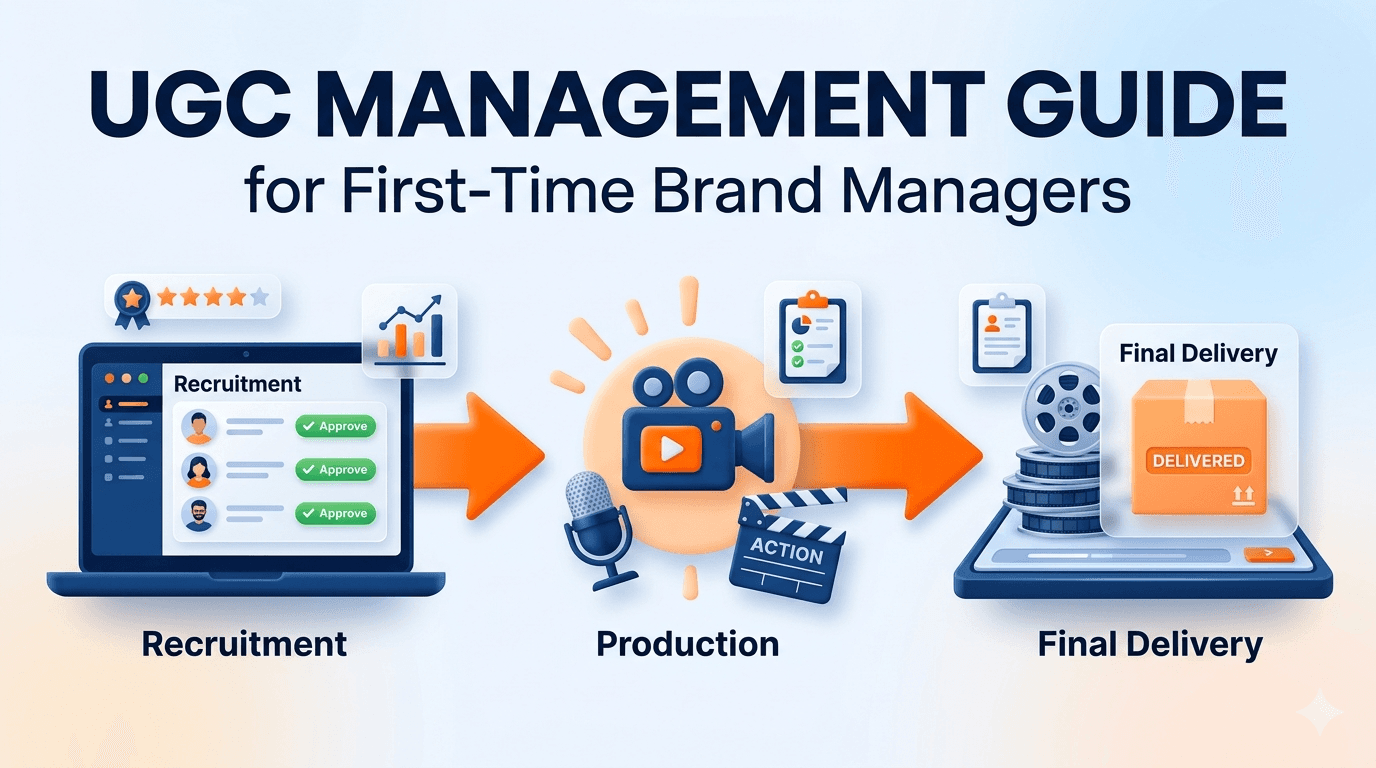
UGC Management Guide for First-Time Brand Managers (2026)

Chukwunyere Ebube
June 21, 2026
UGC Creator Management Tips for First-Time Brand Managers
User-Generated Content (UGC) campaigns yield an average Return on Investment (ROI) of up to 5:1 when executed via strategic, authentic creator partnerships rather than traditional celebrity endorsements (Kadeni, 2026). Meanwhile, over 86% of rising content creators in emerging African markets like Nigeria currently operate in the micro-to-nano tier with fewer than 10,000 followers, representing an incredibly fertile ground of hyper-authentic, localized talent for modern corporate entities (Economy, 2024). Consequently, brand managers face a major structural shift: traditional push-marketing frameworks are collapsing into decentralized, community-driven commerce networks. Therefore, mastering the technical execution of UGC creator workflows has transitioned from an experimental marketing tactic to a critical core competency for digital brand sustainability.
Let's consider a relatable scenario that plays out weekly within the bustling tech and lifestyle hubs of Lagos, Nairobi, and Johannesburg. Imagine Tunde, a newly appointed brand manager for a fast-growing Nigerian fintech app aimed at Gen Z consumers. Eager to drive product adoption, Tunde allocates a significant portion of his quarterly ad budget to source six popular lifestyle creators on TikTok and Instagram to produce "relatable" video reviews showing how easy it is to save money on the app. He sends casual direct messages (DMs), transfers cash upfront via bank apps, and provides a loose, one-sentence brief: "Just make a cool video showing yourself using our app."
Two weeks pass. Three creators ghost him entirely because no legally binding paperwork locked down their timelines. Two creators submit highly stylized, overly polished videos that look exactly like corporate television commercials—completely missing the raw, native aesthetic that drives organic social feeds. The final creator posts a video, but because Tunde failed to secure explicit usage rights in writing, the creator's agency flags the brand's subsequent paid ad amplification for intellectual property violations. Tunde's budget is drained, his campaign timeline is shattered, and his launch stalls. This painful lesson is entirely preventable. It highlights the vast operational gap between treating UGC creators as casual internet freelancers versus treating them as structured operational partners.
By the end of this comprehensive guide, you will learn the precise mechanical blueprint required to source, onboard, manage, legally protect, and analytically optimize a high-performing fleet of UGC creators. We will break down exactly how to protect your brand's capital, build repeatable creative operational engines, and navigate both local African nuances and global digital creator standards to scale your brand’s bottom line.
How Do Digital Brands Successfully Manage UGC Creators Without Burning Budgets?
To avoid the common operational pitfalls that claim first-time marketing campaigns, brand managers must treat user-generated content as a formalized supply chain. It requires systematic inputs, clear legal guardrails, objective performance tracking, and clear, structured communication. Let's join me as we break down the definitive, multi-phase operational blueprint for successful, scalable UGC creator management.
Phase 1: Defining and Sourcing High-Value UGC Assets
1. Micro-Influencers vs. Dedicated UGC Professional Creators
It is vital to establish a clear distinction between a traditional influencer and a dedicated UGC creator. Micro-influencers possess a small, highly engaged, and localized audience niche; their value lies primarily in distributing content directly to their own follower bases (Vitushkin, 2026). Conversely, a dedicated UGC professional focuses entirely on creating high-performing assets designed to live on your brand's owned media channels or to be deployed within your paid social media advertising funnels (Pharr, 2026). The creator's personal follower count is completely irrelevant because the content's visibility is driven by your brand's distribution budgets.
Mixing up these two archetypes will ruin your budget allocation. If you pay an influencer high premium fees solely for their reach, but their creative video-production skills are mediocre, your paid ad performance will crater. Meanwhile, partnering with dedicated UGC creators allows you to acquire high-converting, visually engaging, and psychologically persuasive creative assets at a fraction of the cost, maximizing your Return on Ad Spend (ROAS) (Ntousi et al., 2025).
- Evaluate your core marketing objective: If you require immediate brand awareness within a specific community, allocate 30% of your budget to micro-influencers for organic distribution.
- If your goal is conversion, lead generation, or high-volume ad testing, allocate 70% of your budget to dedicated UGC creators who can supply raw video assets.
- Audit creator portfolios using specialized criteria: look specifically for native platform editing styles, high hook-retention rates in the first 3 seconds, and clear, persuasive call-to-action deliveries rather than just looking at aesthetically pleasing grid photos.
2. Hyper-Localized Sourcing Strategies for Emerging Markets
Hyper-localized sourcing means systematically identifying and hiring creators who naturally speak the regional slang, understand the unique socio-cultural realities, and visually reflect the physical environments of your primary target demographic.
Consumers in emerging African markets possess highly attuned "persuasion knowledge"—a natural cognitive defense mechanism that filters out overly polished, Westernized, or corporate-sounding promotions (Vitushkin, 2026). If a video advertisement features a creator with a foreign accent or sets a lifestyle scene in an environment that looks completely detached from local realities, the target audience instantly disconnects. Localized storytelling accelerates psychological trust and deepens brand affinity (Kadeni, 2026).
- Move away from relying solely on broad global influencer matching databases, which often lack deep, accurate data on African digital niches. Instead, execute targeted manual searches on TikTok and Instagram using localized keyword combinations (e.g., "Lagos skincare creator," "Abuja tech review," "Nairobi lifestyle UGC").
- Scan the comment sections of popular regional niche pages to see which micro-creators are actively engaging and already building authentic, community-driven conversational loops (Vitushkin, 2026).
- Prioritize creators who can smoothly blend localized vernacular (such as Pidgin English, Yoruba, Igbo, or Hausa terms in Nigeria) into their scripts without making it feel forced or performative.
Phase 2: The Onboarding and Legal Framework
3. Airtight Contractual Agreements and Usage Rights
An airtight UGC contract is a legally binding document that explicitly defines the scope of work, content delivery timelines, payment terms, and, most crucially, the exact intellectual property (IP) usage rights and content licensing durations granted to the brand.
A lack of formal legal agreements is the leading cause of failed campaigns, surprise expenses, and legal disputes. Many first-time brand managers mistakenly assume that paying a creator for a video automatically gives the brand perpetual rights to use that video anywhere they want. If you run a creator's video as a paid ad without explicit, written paid media usage rights, the creator or their representing agency can legally issue a takedown notice or demand heavy financial compensation for unauthorized commercial amplification.
- Never execute a campaign without a signed contract. Utilize structured legal templates customized for digital media operations.
- Clearly detail the Usage Scope: Explicitly state whether the content is for organic use only, or if the brand possesses "Paid Media Amplification Rights" (often referred to as whitelisting or spark ads).
- Define the Usage Duration: Specify a clear timeframe (e.g., 30 days, 90 days, or perpetual) for paid ad deployment. In emerging markets, securing a 60-to-90-day paid usage window is typically the most cost-effective approach for seasonal campaigns.
- Include a clear Exclusivity Clause if necessary, which legally prevents the creator from creating content for direct market competitors for a specified duration.
4. Structured Content Briefs vs. Creative Freedom
A structured content brief is a comprehensive guide that outlines a campaign's objectives, required product communication points, mandatory compliance boxes, and technical formatting specifications. This must be perfectly balanced with giving the creator enough creative freedom to keep their native, authentic performance style intact.
If your brief is too rigid and micro-manages every single sentence, the resulting video will sound stiff, scripted, and commercialized. This instantly triggers consumer defenses and lowers engagement (Luarn et al., 2015). Conversely, if your brief is too loose and completely hands over control, the creator might produce a fun, engaging video that entirely forgets to highlight your product's key value propositions or unique selling points.
Use a balanced, highly effective three-part briefing structure:
- The Guardrails: Define the mandatory technical requirements (e.g., 9:16 vertical format, high-resolution 1080p capture, no background music protected by copyright, zero visible logos from competing brands).
- The Concept Guide: Provide a clear, strategic framework for the flow of the video, outlining the exact hooks and call-to-actions needed while letting the creator write the middle in their own voice.
- The Do-Not-Say List: Provide a crystal-clear list of phrases, compliance missteps, or inaccurate product claims that the creator must completely avoid.
Phase 3: Execution, Communication, and Workflow Automation
5. Milestone-Based Communication and Deadlines
Milestone-based management is an operational framework where a creator's project is broken down into small, visible stages—such as script approval, rough-cut review, final-edit validation, and publication. Each stage acts as a mandatory checkpoint before the project can move forward.
Creators are frequently juggling multiple projects simultaneously. If you assign a task and simply say, "Send me the final video in two weeks," you are setting yourself up for potential failure. The creator might wait until the very last night, skip creating a strategic script, or film something that completely misinterprets your brand guidelines. Discovering these major conceptual errors only after the final video is completely filmed and edited means you either have to waste time demanding complete reshoots or end up delaying your entire campaign schedule.
Build and enforce a highly disciplined milestone schedule for every single creator partnership. Let's see how this breaks down:
- Milestone 1: Script & Concept Outline Approval. The creator must submit their written hook, core concept, and dialogue lines within 3 business days of receiving the brief. This lets you catch and fix any messaging issues before a camera even turns on.
- Milestone 2: The Rough Cut Submission. The creator delivers the first raw video edit without music, colored filters, or text overlays. This checkpoint lets you audit visual framing, lighting quality, product visibility, and audio clarity.
- Milestone 3: Final Edited Asset Delivery. The creator hands over the polished, high-resolution video complete with agreed-upon captions, native text safe-zones, and asset variations.
6. Setting Up Tracking Infrastructure
Setting up tracking infrastructure means implementing unique, trackable data points—such as UTM parameters, customized discount codes, and dedicated analytics pixels—for every individual creator in your campaign.
Without proper attribution tracking, you are operating completely in the dark. You might see a general lift in website traffic or application downloads during the campaign, but you will have zero visibility into which specific creator actually generated those conversions versus which creators underperformed. Relying on superficial "vanity metrics" like likes, comments, or views can be deeply misleading; a video can easily accumulate millions of views from an irrelevant demographic without driving a single actual business conversion or signup.
- Generate distinct, customized tracking links for every single creator using a structured analytics builder (e.g., `yoursite.com/?utm_source=tiktok&utm_medium=ugc&utm_campaign=productlaunch&utm_content=creator_name`).
- Create personalized, memorable promo codes for each creator within your e-commerce or backend database (e.g., `CREATOR50`, `TUNDE10`) to capture conversions that happen outside of direct link clicks.
- Deploy conversion tracking pixels on your landing pages to measure long-term performance trends, helping you calculate exactly which creator assets deliver the best Lifetime Value (LTV) and Customer Acquisition Cost (CAC) efficiencies (Vitushkin, 2026).
Phase 4: Optimization, Compensation, and Post-Campaign Scaling
7. Data-Driven Asset Optimization and Iteration Strategy
Data-driven asset optimization is the systematic practice of analyzing initial ad performance metrics, identifying exactly where viewers lose interest, and modifying specific parts of those video assets to lift engagement and conversion rates.
The absolute magic of user-generated content lies in its flexibility. In the fast-moving digital media landscapes of 2026, you don't just discard a piece of content simply because its initial launch numbers were average. Often, a UGC video fails to convert purely because its first 3 seconds didn't grab attention, while the core message remains incredibly strong. By identifying these specific bottlenecks and swapping out elements like the opening hook, you can turn a low-performing ad asset into an incredibly efficient engine for your brand.
- Analyze your video retention graphs inside your ad account. If you spot a sharp drop-off in viewers within the very first 3 seconds, it means the opening hook failed to grab them. Request the creator to record 3 entirely different, high-energy hook variations for that exact same video body.
- If the viewer retention graph remains high throughout the video but your conversion numbers are low, the bottleneck lies at the end. Your call-to-action is likely weak, confusing, or uninspired. Edit the asset to feature a much more direct, visually urgent call-to-action.
- Continuously test different visual variations: try pairing the creator's voiceover with different background clips, altering the text overlay placements, or testing different music pacing to systematically optimize your performance returns.
8. Compensation Models Tailored for Local and Global Creatives
A compensation model defines the financial structure of your creator agreements, choosing between flat-fee payments, performance-based commissions, free product exchanges (gifting), or a hybrid blend of these options.
Relying on a rigid, one-size-fits-all payment structure will severely limit your ability to scale. Top-tier, professional UGC creators who understand their financial value will rarely accept purely speculative, commission-only deals. On the flip side, paying high flat fees to unverified creators before they deliver any proven business value exposes your brand to massive financial risk. Designing flexible compensation models allows you to optimize your budget allocation across different tiers of talent.
- The Gifting Model: Best utilized for rising nano-creators. Send them your physical product or offer free, full access to your digital service platform in exchange for an honest video review. This is an incredibly cost-effective way to build a high volume of initial baseline assets.
- The Flat-Fee Tier: Reserve set cash payments for verified, professional UGC creators who consistently deliver high-quality, technically sound video assets that strictly match your briefing guidelines.
- The Performance Hybrid Model: This is the golden standard for scalable growth. Pay an accessible, foundational flat fee upfront to cover the creator's immediate production and editing labor, and combine it with a performance-based bonus structure (such as a 10% commission on every validated sale or a cash bonus for hitting specific signup milestones). This aligns the creator's financial incentives directly with your brand's growth goals.
Phase 5: Step-by-Step Campaign Launch Sequence
To ensure your very first campaign launches flawlessly without a hitch, let’s transition into an actionable operational roadmap. The following sequence details exactly how to manage your creators chronologically across a standard 30-day campaign lifecycle:
How Do Brand Managers Handle UGC Creators Who Fail to Meet Deadlines?
Dealing with creator delays, sudden lack of communication, or low-quality initial drafts is an inevitable part of managing creative talent. The key to handling these situations effectively lies in building proactive, structured systems rather than relying on reactive frustration. If a creator misses a deadline, your first step is to reference the signed contract. Professional contracts should always include a clear clause stating that payments are strictly tied to meeting approved milestone dates.
When a creator delivers a video that completely misses the mark visually or fails to follow your brief, avoid giving vague, emotional feedback like "This doesn't feel right" or "Make it more exciting." Creators cannot execute on abstract vibes. Instead, provide clear, timestamped, actionable instructions:
"At the 0:05 mark, please remove the background noise. At 0:14, ensure the product label is fully visible and facing the camera. At 0:25, please re-record the call-to-action phrase to match the exact wording in Section 3 of our brief."Providing crisp, professional, and clear feedback keeps your campaign moving forward efficiently without straining creative partnerships.
Conclusion: Building a Sustainable Creator Engine
Scaling a digital brand in today's landscape requires moving away from manual, uncoordinated influencer interactions and stepping into structured, data-driven creator operations. User-generated content is uniquely powerful because it mirrors the natural, human storytelling styles that consumers instinctively trust. By treating your UGC management as a formalized, step-by-step pipeline—enforcing clear contracts, using milestone-driven briefs, deploying rigorous tracking, and optimizing assets based on performance data—you protect your marketing budgets while building a repeatable engine for sustainable brand growth.
Are you ready to stop chasing vanity metrics and start launching high-converting, professionally managed UGC campaigns that drive real revenue? Let’s partner together to scale your brand. Head over to Adminting.com today to explore our premium talent management suites, download custom operational toolkits, and book a strategic growth consultation with our expert content optimization teams!
Frequently Asked Questions (FAQ)
1. What is the standard payment rate for a UGC creator in Nigeria?
UGC compensation varies significantly based on experience, production quality, and required usage rights rather than just follower count. In Nigeria's digital space, baseline rates for a single high-quality, edited vertical video asset from a micro-tier creator typically range between ₦30,000 to ₦100,000. Experienced, top-tier professional UGC creators who provide advanced lighting, crisp audio, and include extended paid media advertising usage rights may range from ₦150,000 to ₦400,000+ per asset. Implementing performance hybrid models is highly recommended to optimize your total spend.
2. Can we use a creator's UGC video for paid Facebook and TikTok ads indefinitely?
No, you cannot run a creator's content indefinitely unless your signed contract explicitly includes a "perpetual, worldwide paid media usage and distribution license." Standard creator agreements generally grant organic usage rights forever, but limit paid ad amplification rights to specific windows like 30, 60, or 90 days. Always ensure your legal contracts clearly define these timelines upfront to avoid intellectual property flags, unexpected billing fees, or costly campaign takedown demands.
3. How do I know if a creator’s engagement rate is authentic or fake?
To accurately spot artificial engagement, look closely past basic follower numbers and dive straight into the quality of the comment sections. Authentic creators feature meaningful, topically relevant conversations, specific questions about the content, and unique human expressions from their audience. If you notice a comment section filled with repetitive single-emojis, generic phrases like "nice pic" or "follow back," or notice massive spikes in views alongside near-zero comments, the page likely uses automated growth bots. Always cross-examine a creator's video view-to-follower ratios over a 30-day window to evaluate true consistency.
4. Do I need to send my physical product to the creator, or can they use green screens?
Whenever possible, shipping the actual physical product directly to the creator is highly recommended. Authentic user-generated content thrives on physical interaction—viewers want to see the product being unboxed, texture closeups, real-time application, and natural human reactions. Green screens and digital overlays can be used for secondary educational breakdowns or app reviews, but over-relying on digital mockups can make your content look detached and commercial, which lowers conversion rates.
References
- Economy, C. (2024). Africa Creator Economy Report - Communiqué. Communiqué HQ. https://communiquehq.com/s/Africa-Creator-Economy-Report-2024.pdf
- Kadeni, K. (2026). Product branding transformation in the digital age: Strategy, identity, and consumer loyalty for MSMEs. International Journal of Educational Studies, 3(2), 89-105. https://languar.net/index.php/INJOSEDU/article/download/752/711
- Luarn, P., Lin, Y. F., & Chiu, Y. P. (2015). Influence of social media content type on consumer engagement. Journal of Social Media Marketing, 11(3), 154-168.
- Ntousi, E., Lazaris, C., Katiaj, P., & Koukopoulos, A. (2025). Directed Consumer-Generated Content (DCGC) for Social media marketing: Analyzing performance metrics from a field experiment in the publishing industry. Systems, 13(2), 124. https://doi.org/10.3390/systems13020124
- Pharr, J. M. (2026). A framework for integrating content marketing and social media engagement for more effective university branding. Digital Commons @ Kennesaw State University, 14-22. https://digitalcommons.kennesaw.edu/cgi/viewcontent.cgi?article=1858&context=ama_proceedings
- Vitushkin, I. (2026). Funnel transformation and increased business ROI through blogger advertising. International Journal of Research in Commerce and Management Studies, 8(2), 258-273. https://ijrcms.com/uploads2026/ijrcms_08_681.pdf
Related Recommendations
To further sharpen your corporate marketing strategies and maximize your operational workflows, explore these comprehensive guides from the Adminting digital strategy library:
- Maximizing Influencer Marketing ROI: A Complete Data Attribution Guide for Modern Brands
- Scaling Content Operations: How to Build Repeatable Asset Creation Engines Without Overworking Teams
- The Complete Legal Blueprint: Navigating Intellectual Property and Usage Rights in African Creator Partnerships