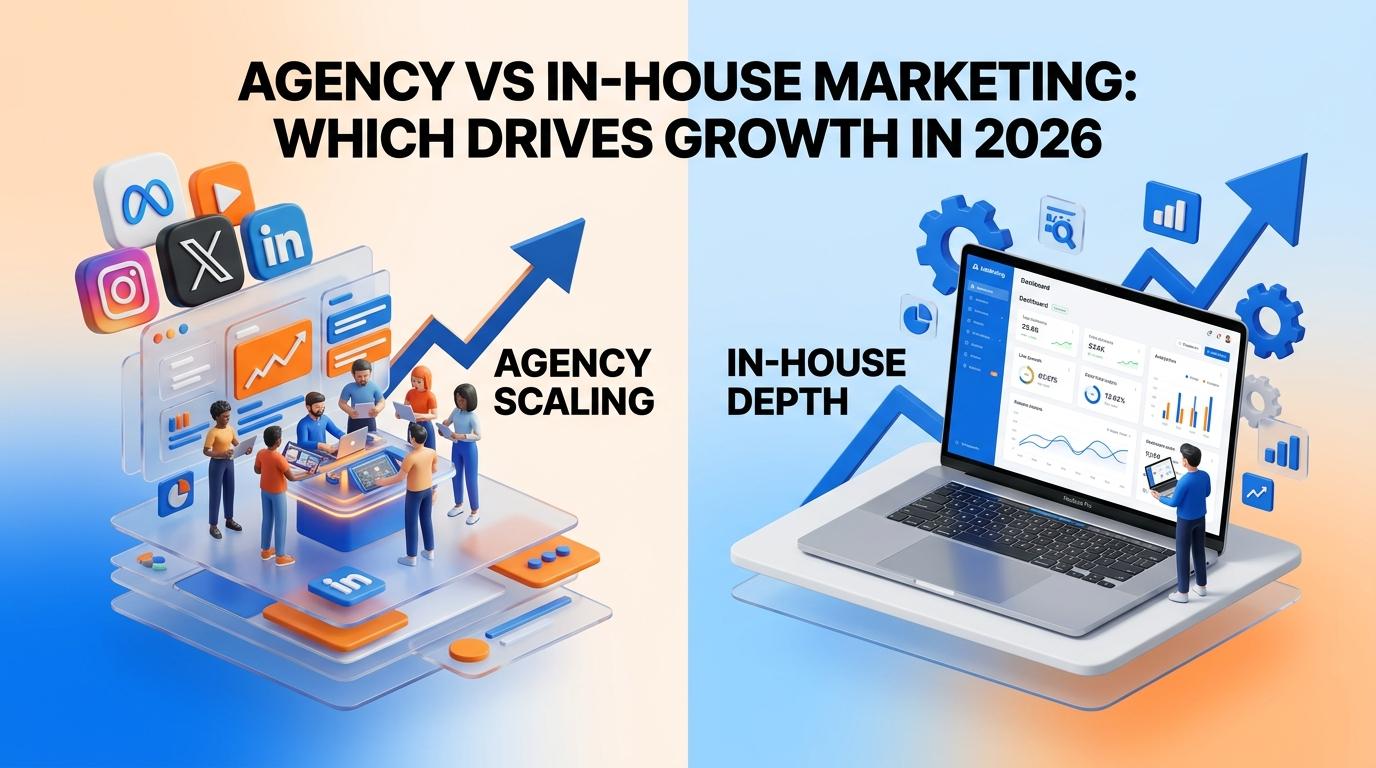
Agency vs In-House Marketing

Chukwunyere Ebube
September 30, 2026
Agency vs In-House Marketing: Which Drives Growth?
Did you know that over 68% of marketing budgets across Nigeria, West Africa, and the global digital ecosystem are lost to fragmented marketing strategies, unoptimized ad spend, and high employee turnover rates? In 2026, the Nigerian e-commerce market expands past $10.49 billion, while total digital ad spend across social media, online video, and search networks tops $1 billion locally.
However, growth-focused brand managers, startup founders, and corporate directors continually face a major strategic dilemma: Should you hire a specialized digital marketing advertising agency or build an in-house marketing team?
| THE 2026 MARKETING DILUTION GAP |
|---|
| [ In-House Alone ] --> Overhead & Skill Bottlenecks |
| [ General Agency Alone ] --> Vanity Metrics & Unaligned Goals |
| [ Performance Partner ] --> Scalable ROI & Revenue Velocity |
Choosing the wrong execution model drains your capital, delays market entry, and hands market share directly to your competitors. Meanwhile, consumer attention shifts rapidly between TikTok, Instagram, WhatsApp status micro-influencer networks, and search platforms.
In this comprehensive guide, we will break down the true costs, hidden operational friction, technical capabilities, and conversion speed of both models. As a result, you will gain the exact data and frameworks needed to scale your digital reach, lower Customer Acquisition Cost (CAC), and maximize Return on Ad Spend (ROAS).
Consider two fast-growing consumer brands operating out of Victoria Island, Lagos: Brand A (FinTech Direct) and Brand B (OmniRetail Africa). Both set out with an identical goal at the start of the fiscal year: expand customer acquisition by 300% while maintaining a target CAC of under ₦4,500 per funded user.
| TALE OF TWO LAGOS-BASED BRANDS | |
|---|---|
| BRAND A (IN-HOUSE STRATEGY) | BRAND B (HYBRID PERFORMANCE PARTNER) |
|
|
Brand A: The In-House Struggle
Brand A chose to build a dedicated in-house team. Consequently, they posted job offers, spent six weeks interviewing candidates, and eventually hired four full-time specialists: a Media Buyer, a Content Creator, a Graphics Designer, and a Digital Strategy Lead.
Their combined monthly payroll exceeded ₦5,500,000 (roughly $3,800), not including office workspace overhead, hardware provisioning, premium software subscriptions, pension, and health insurance.
Within three months, macroeconomic shifts hit. Meta adjusted its auction algorithms, TikTok expanded search monetization, and local influencer rates surged. Brand A's in-house team was overwhelmed. The graphics designer was stuck making basic social media carousels instead of high-converting ad visuals. The media buyer lacked specialized data analytics skills to diagnose creative fatigue. Furthermore, six months into the campaign, their head media buyer resigned for an international remote offer.
As a result, campaign optimization ground to a complete halt, their CAC surged to ₦11,200, and their marketing runway shrank drastically.
Brand B: The Performance Agency Advantage
Conversely, Brand B took a hybrid, performance-led approach. They retained a lean internal team consisting of one Senior Marketing Manager to protect brand voice and aligned directly with a specialized growth agency.
Instead of waiting months to build internal capabilities, Brand B tapped into a ready-made team of data analysts, performance media buyers, conversion rate optimization (CRO) specialists, and micro-influencer network managers.
The agency immediately deployed dynamic User-Generated Content (UGC) ad frameworks across TikTok and Meta, optimized private WhatsApp distribution channels, and integrated end-to-end event tracking.
Meanwhile, their campaign performance was monitored daily against hard revenue metrics rather than vanity impressions. Consequently, within 60 days, Brand B reduced its CAC to ₦3,800, scaled user acquisition by 340%, and dominated its product category across West Africa.
By the end of this post, you will learn the exact operational differences between hiring a digital marketing advertising agency and building an in-house marketing team.
Specifically, you will discover the hidden financial costs of both approaches, an in-depth breakdown of technical capabilities, a clear 10-point evaluation matrix, real-world ROI benchmarks for the African market, and actionable frameworks to decide which model fits your business goals today.
How do high-growth brands in Nigeria and across global emerging markets consistently decide between an agency partnership and an in-house marketing setup without burning capital or missing growth targets? Join me as we get answers to burning issue.
Digital Marketing Agency vs. In-House Team
Navigating the choice between an agency and an in-house team requires analyzing your business maturity, budget size, technical requirements, and market expansion velocity. Below is an exhaustive breakdown across eight essential decision pillars.
| AGENCY VS IN-HOUSE AT A GLANCE | ||
|---|---|---|
| CRITERIA | IN-HOUSE TEAM | PERFORMANCE AGENCY |
| Time-to-Market | 60–90 Days (Hiring/Onboard) | 7–14 Days (Plug-and-Play) |
| Monthly Fixed Overhead | Very High (Salaries, Tools) | Predictable / Performance |
| Skill Diversity | Limited to In-House Roles | Complete Omnichannel Suite |
| Tech & Tool Stack | High Direct SaaS Expense | Included in Agency Stack |
| Agility & Pivot Speed | Slow (Internal Red Tape) | Fast (Cross-Industry Data) |
| Campaign Accountability | High Risk (Single Points) | Contractual SLA & KPIs |
Pillar 1: Financial Structure & Cost Overhead
Financial structure refers to the total monetary investment required to maintain a functional marketing capability. For an in-house team, this involves fixed monthly compensation, statutory benefits, workspace, technology licensing, and recruitment costs.
For a digital advertising agency, this involves retainers, performance-based fee structures, or project-based billing models.
| IN-HOUSE TEAM ANNUAL COST BREAKDOWN (NIGERIA/WEST AFRICA) | |
|---|---|
| COST CATEGORY | ESTIMATED ANNUAL COST (NGN) |
| Lead Growth Strategist / Manager | ₦12,000,000 - ₦18,000,000 |
| Senior Performance Buyer | ₦8,400,000 - ₦12,000,000 |
| UGC / Content Specialist | ₦4,800,000 - ₦7,200,000 |
| Motion & Visual Designer | ₦4,800,000 - ₦7,200,000 |
| SaaS Tools (Semrush, AppsFlyer, etc.) | ₦6,000,000 - ₦10,000,000 |
| Recruitment & Workspace Hardware | ₦3,500,000 - ₦5,000,000 |
| TOTAL ESTIMATED ANNUAL COST | ₦39,500,000 - ₦59,400,000 |
Understanding the true monetary consequence prevents sudden cash-flow strain. Building an internal team locks capital into fixed liabilities regardless of market conditions or revenue seasonalities.
Conversely, partnering with an agency converts fixed personnel costs into variable or performance-linked growth expenses.
Actionable Steps
Step-by-Step Financial Audit
Calculate Fully Loaded In-House Costs: Sum annual base salaries, tax contributions, pension, health insurance, paid leave, equipment provisioning, and onboarding expenses.
Audit SaaS and Data Infrastructure Costs: Factor in tools such as Semrush, Ahrefs, Mixpanel, Hootsuite, AppsFlyer, and specialized creative AI suites.
Compare Against Agency Retainers: Weigh total in-house expenses against an agency retainer that provides immediate access to senior strategists, copywriters, video editors, and media buyers.
Evaluate Financial Risk: Determine whether your brand can sustain high fixed personnel costs during market downturns or pivot cycles.
Pillar 2: Breadth and Depth of Talent
Talent depth represents the variety, specialization, and expertise of the personnel executing your marketing strategies.
In-house setups usually consist of 2 to 5 generalists who manage multiple channels simultaneously. In contrast, an agency maintains dedicated, channel-specific experts in performance advertising, data analytics, media buying, SEO, and micro-influencer management.
Digital marketing is no longer just about posting graphics or running basic boosted posts. Modern acquisition requires advanced data analytics, SQL queries, conversion rate optimization, programmatic media buying, and AI-driven UGC creation.
Expecting a small in-house team to excel across all these disciplines often leads to creative fatigue, high error rates, and stagnant ROAS.
Actionable Steps
Deploying Multi-Disciplinary Talent
Identify Skill Gaps: Map your growth targets against your team's current technical skill set.
Eliminate Single-Point Dependencies: Ensure your growth engine isn't vulnerable if a key employee leaves.
Leverage Cross-Industry Insights: Tap into agency teams that manage campaigns across diverse verticals (FinTech, E-commerce, HealthTech, EdTech) to quickly adopt cross-industry best practices.
Deploy Specialized Execution: Assign deep technical tasks—such as conversion API tracking, SQL dashboard configuration, and programmatic bidding—to dedicated specialists.
Pillar 3: Technology Stack, Data Analytics, and Infrastructure
MarTech (Marketing Technology) encompasses the software, data pipelines, analytics engines, and tracking pixels used to measure, optimize, and scale campaigns. This includes server-side conversion APIs, heatmapping tools, competitive intelligence software, and influencer verification databases.
| ESSENTIAL MODERN MARTECH STACK | ||
|---|---|---|
| TOOL CATEGORY | PURPOSE | TYPICAL MONTHLY COST |
| Analytics & SQL | Data pipelines, user attribution | $300 - $1,200 |
| SEO & Market Intel | Keyword & competitor tracking | $200 - $800 |
| Creative & AI UGC | Video editing & image generation | $150 - $500 |
| CRO & Heatmapping | Landing page conversion tests | $200 - $600 |
| Influencer Verification | Fraud detection & escrow tracking | $400 - $1,500 |
Without advanced technology and real-time data analytics, modern advertising is just guessing.
Unoptimized tracking leads to misattributed conversions, wasted ad spend, and inaccurate audience targeting. However, acquiring an enterprise MarTech stack independently can cost single brands thousands of dollars every month. Agencies distribute these software costs across multiple clients, giving you access to top-tier enterprise infrastructure out of the box.
Actionable Steps
Building a Data-First Infrastructure
Implement Server-Side Tracking: Configure Conversion APIs (CAPI) on Meta, TikTok, and Google to bypass browser privacy blocks and signal loss.
Unify Analytics Dashboards: Aggregate campaign data into clear reporting systems to monitor true Customer Lifetime Value (LTV), CAC, and ROAS in real time.
Use Verified Creator Platforms: Partner with infrastructure platforms like Adminting.com to verify micro-influencer engagement metrics, track link clicks, and prevent follower fraud.
Conduct CRO Experiments: Run continuous A/B multivariate tests on landing pages to systematically eliminate checkout friction.
Pillar 4: Scalability, Agility, and Onboarding Speed
Scalability and agility measure how quickly a brand can expand into new channels, launch large-scale campaigns, or pivot strategy in response to sudden market shifts.
| ONBOARDING & SCALING TIMELINE COMPARISON |
|---|
|
IN-HOUSE TEAM: Week 1-4: Job Postings & Interviews Week 5-8: Onboarding, Hardware Setup, Tool Provisioning Week 9-12: Campaign Framework Development & Trial Execution TOTAL: ~90 Days to Full Execution PERFORMANCE AGENCY: Day 1-3: Strategic Audit, Goal Alignment, Pixel & API Integration Day 4-7: Creative Strategy, UGC Sourcing, Funnel Setup Day 8-14: Live Campaign Launch & Real-Time Data Optimization TOTAL: ~14 Days to Full Execution |
Market conditions across Africa change rapidly. Macroeconomic shifts, regulatory updates, currency fluctuations, and emerging platform trends require immediate strategic pivots.
An in-house hiring process takes 60 to 90 days from job post to full productivity. Conversely, an established agency offers plug-and-play scaling, allowing you to launch high-converting campaigns within days.
Actionable Steps
Rapid Campaign Deployment
Execute Immediate Growth Audits: Analyze historical ad accounts, conversion tracking setups, and creative assets to spot quick optimization wins.
Deploy Modular Ad Creative Systems: Build multi-angle creative assets (UGC, static banners, motion graphics) to test messaging quickly.
Scale Budget Responsively: Allocate ad spend dynamically to winning channels (e.g., shifting budget from Meta to TikTok or Search) based on real-time ROAS data.
Use Established Ecosystems: Utilize creator networks to launch localized campaigns without needing individual contract negotiations.
Pillar 5: Market Context and Localization (Nigeria & West Africa Focus)
Localization is the practice of tailoring marketing messages, distribution channels, and offers to local consumer habits, cultural nuances, and regional economic realities.
| NIGERIAN DIGITAL MEDIA DISTRIBUTION MATRIX | ||
|---|---|---|
| CHANNEL | MARKET RECOVERY / REACH IMPACT | ADOPTION TYPE |
| WhatsApp Communities | High-Trust Direct Messaging | Conversational Commerce |
| TikTok & Instagram | Mass Visual & Video Discovery | Creator-Led / UGC Ads |
| Search Engines | Intent-Driven High Conversion | SEO & Google Ads |
| Video Networks | High Brand Awareness Growth | YouTube & Display |
Generic global playbooks often fail in Nigeria and broader African markets if they ignore local realities. Local buyers respond strongly to word-of-mouth recommendations, peer reviews, social proof, dynamic WhatsApp communities, and localized payment solutions.
Agencies anchored in local ecosystems understand how to navigate regional payment gateways, overcome high last-mile logistics friction, and tap into hyper-engaged private messaging groups.
Actionable Steps
Crafting High-Converting Localized Strategy
Leverage WhatsApp Status & Micro-Influencers: Reach target audiences through trusted niche creators rather than relying solely on expensive celebrity endorsements.
Optimize for Mobile-First Usage: Ensure landing pages load quickly under local 4G networks and work seamlessly on mobile browsers.
Address Currency & Payment Preferences: Display clear pricing structures and integrate options like Cards, Bank Transfers, and Buy-Now-Pay-Later (BNPL) to boost conversion rates.
Engage Private Digital Communities: Deploy promotional offers directly into targeted Telegram, WhatsApp, and Discord groups where engagement rates often top 60%.
Pillar 6: Creative Production and UGC Fatigue Prevention
Creative production involves making ad visuals, short-form video content, ad copy, and landing pages. Creative fatigue occurs when your target audience sees the same ad creative too many times, leading to lower Click-Through Rates (CTR) and rising acquisition costs.
In 2026, audience attention spans are shorter than ever, making creative execution the primary driver of ad performance. Over 80% of consumer buying decisions across Nigeria and West Africa are shaped by authentic User-Generated Content (UGC).
In-house teams frequently run out of creative ideas because they lack dedicated video production systems. Conversely, agencies maintain continuous pipelines of creators to refresh ad angles before creative fatigue sets in.
Actionable Steps
Building a Creative Engine
Script Dynamic Hook Angles: Draft 5 to 10 distinct video hooks for every core offer to test attention capture within the first 3 seconds.
Partner with Verified UGC Creators: Source relatable content creators who match your target demographic to record authentic product reviews.
Track Frequency and Ad Fatigue Metrics: Monitor ad frequency metrics; when frequency exceeds 3.5 and CTR drops, swap in new creative variations immediately.
Use Modular Design Frameworks: Systematically swap out video headlines, background music, call-to-action buttons, and voiceovers to create fresh ad combinations.
Pillar 7: Accountability, Performance-Linkage, and Objective Oversight
Accountability defines how performance success is measured and enforced. An in-house team is evaluated via traditional workplace performance reviews and monthly salaries.
An agency operates under formal Service Level Agreements (SLAs), clear Key Performance Indicators (KPIs), and contractual performance targets tied to actual revenue growth.
| VANITY METRICS VS HARD REVENUE KPIS | |
|---|---|
| VANITY METRICS (AVOID WRONG FOCUS) | HARD REVENUE METRICS (ADMINTING FOCUS) |
| Raw Impressions & Ad Reach | Customer Acquisition Cost (CAC) |
| Social Media Likes & Shares | Return On Ad Spend (ROAS) |
| Total Unqualified Page Views | Conversion Rate % & Cost Per Lead (CPL) |
| Basic Follower Count Growth | Net Revenue Generated & Customer LTV |
Internal teams can fall victim to confirmation bias or get distracted by "vanity metrics" like likes, impressions, and follower counts.
However, external agencies maintain objective focus on hard revenue metrics: sales conversions, qualified leads, app installs, and net business growth.
Actionable Steps
Establishing a Performance-Driven Accountability Framework
Set Hard Metric Benchmarks: Define non-negotiable target numbers for CAC, ROAS, Cost Per Lead (CPL), and Net Revenue before spending budget.
Tie Compensation to Results: Incorporate performance incentives into agency retainers to align campaign success with business revenue.
Enforce Weekly Performance Audits: Schedule weekly analytics reviews to inspect real conversion metrics, address bottlenecks, and reallocate budgets.
Maintain Transparency via Escrow and Tracking: Use secure campaign tracking systems to ensure ad budgets are spent effectively on verified metrics.
Pillar 8: Risk Management, Employee Turnover, and Strategic Continuity
Risk management involves protecting your brand's growth engine against operational disruption, employee resignations, technical failures, or unexpected platform policy updates.
| STRATEGIC CONTINUITY FRAMEWORK |
|---|
|
IN-HOUSE RISKS: [ Key Employee Resigns ] ---> [ Loss of Knowledge ] ---> [ Campaign Halts ] AGENCY RESILIENCE: [ Multi-Tiered Team ] ---> [ Standard Operating Protocols ] ---> [ Smooth Growth] |
In competitive markets, skilled digital talent moves frequently. When a key in-house media buyer or strategist leaves, they take campaign history, technical setup details, and optimization experience with them.
This creates severe operational delays while you recruit and train a replacement. Agency partnerships insulate your brand from turnover risks, providing continuous campaign management backed by team redundancies and documented protocols.
Actionable Steps
Mitigating Growth Risks
Document All Standard Operating Procedures (SOPs): Maintain central documentation for all campaign setups, audience profiles, pixel implementations, and ad accounts.
Maintain Multi-Tiered Account Management: Ensure at least three team members understand your campaign structure and history.
Enforce Strict Account Ownership: Always host ad accounts, tracking dashboards, and pixels under your owned business manager profiles rather than personal employee accounts.
Conduct Bi-Annual Strategic Reviews: Routinely review performance strategy against emerging market trends, channel updates, and competitive moves.
When does a hybrid model (In-House Brand Lead + Performance Agency) make the most strategic sense for a growing business?
A hybrid model makes the most sense when a company reaches an intermediate growth stage, typically generating consistent revenue and requiring both deep brand messaging control and high-velocity digital execution.
| THE HYBRID ENGINE ARCHITECTURE |
|---|
|
[ Internal Brand Manager ] <---> [ Performance Agency (Adminting) ]
RESULT: Strategic Control + High-Velocity Execution & Revenue Growth |
In this setup, your internal Brand Lead owns product development, customer feedback, and brand voice guidelines. Meanwhile, the performance agency handles media buying, data analytics, creative production, ad testing, and conversion funnel optimization.
Consequently, your internal team stays focused on product quality and operations, while the external agency drives predictable customer acquisition and revenue growth.
Why Adminting is Africa’s Premier Performance-Driven Agency
When choosing an agency partner in Nigeria, across West Africa, and globally, generic marketing services often deliver little more than vanity metrics, stock graphics, and unoptimized ad spend. Adminting is engineered differently, standing out as Africa’s premier performance-driven creator economy and digital advertising agency platform.
| THE ADMINTING ADVANTAGE MATRIX |
|---|
| 1. CONVERSION-FIRST ENGINE: Tracks hard revenue, link clicks, and sales. |
| 2. VERIFIED CREATOR NETWORK: Authenticated micro-influencer ecosystem. |
| 3. NICHE COMMUNITIES DISTRIBUTION: Direct WhatsApp & Telegram access. |
| 4. ESCROW-PROTECTED TRUST: Secure budgets linked to verified milestones. |
| 5. OMNICHANNEL DATA ANALYTICS: Real-time SQL dashboards & CRO optimization. |
Key Adminting Features and Capabilities:
Conversion-First Performance Engine: Unlike traditional agencies that report on basic impressions and pageviews, Adminting focuses on hard conversion metrics—tracking link clicks, lead forms, mobile app installs, and actual sales conversions.
Verified Creator Ecosystem: Gain instant access to authenticated micro-influencers and UGC creators across Nigeria, Ghana, Kenya, and South Africa. Audience demographics, engagement metrics, and historical performance are fully verified to protect your budget from follower fraud.
Private Community Distribution Networks: Beyond public feeds like Instagram and TikTok, Adminting reaches target audiences in private digital spaces—including niche WhatsApp status networks, Telegram channels, and Discord communities where engagement rates often cross 60%.
Escrow-Protected Trust & Accountability: Campaign budgets are securely protected in escrow and released only when agreed deliverables and performance milestones are fully met.
Omnichannel Data & Attribution Analytics: Adminting integrates server-side tracking, custom SQL dashboards, and conversion rate optimization to eliminate ad spend waste and maximize long-term ROAS.
Conclusion
Choosing between a digital marketing advertising agency and an in-house team is not just about comparing costs, it is about choosing how fast and reliably your business can grow. While an in-house team offers direct day-to-day access, it often comes with heavy fixed overhead, tool costs, recruitment delays, and skill gaps in modern data analytics and performance advertising.
Partnering with a performance-driven agency like Adminting provides immediate access to specialized talent, advanced MarTech infrastructure, and proven UGC frameworks designed to scale revenue quickly while keeping acquisition costs low.
Ready to stop wasting ad spend on vanity metrics and build a high-ROI growth engine tailored to Nigeria and global markets?
👉 Partner with Adminting Today to launch your next performance-driven growth campaign!
FAQ
-
What is the average cost of hiring a digital marketing agency in Nigeria compared to building an in-house team?
Building an effective in-house marketing team in Nigeria generally costs between ₦39,500,000 and ₦59,400,000 annually when factoring in salaries, software tools, equipment, workspace overhead, and recruitment expenses. Conversely, hiring a performance-driven agency like Adminting usually costs a fraction of that overall commitment, while providing immediate access to a full team of senior specialists and enterprise technology.
-
Can a business combine an in-house team with a digital advertising agency?
Yes, this hybrid model is highly effective. In this setup, an internal marketing manager oversees brand positioning, messaging, and product strategy, while an external performance agency manages technical media buying, data analytics, UGC video production, and conversion optimization.
-
How quickly can an agency launch campaigns compared to an in-house team?
While recruiting and onboarding an in-house team can take 60 to 90 days, an established agency like Adminting can audit your funnels, integrate tracking, source content creators, and launch targeted campaigns within 7 to 14 days.
-
How does Adminting prevent ad spend waste on influencer campaigns?
Adminting uses a conversion-focused platform featuring verified creator engagement metrics, real-time link tracking, and escrow budget protection. Budgets are released only when specific deliverables and performance goals are met, protecting brands from follower fraud and vanity metric reporting.
Reference
Adminting Blog (2026). Roles of a Performance Advertising Agency in Brand Campaigns. Available at: https://www.adminting.com/blogs/roles-of-a-performance-advertising-agency-in-brand-campaigns
Adminting Blog (2026). What Is a Giveaway? Meaning, Examples, and How It Works. Available at: https://www.adminting.com/blogs/what-is-a-giveaway-meaning-examples-how-it-works
Adminting Blog (2025). Adminting: Leveraging Niche Strategies For Industry Leadership. Available at: https://www.adminting.com/blogs/adminting-leveraging-niche-strategies
DataReportal (2026). Digital 2026: Nigeria Report on Internet & Social Usage. Available at: https://datareportal.com/reports/digital-2026-nigeria
Krestel Digital (2025). Nigeria's Digital Marketing Data & Spend Report. Available at: https://kresteldigital.com/resources/nigerias-digital-marketing-data-2025-report/
Mordor Intelligence (2026). Nigeria E-Commerce Market Size & Growth Forecast (2026–2031). Available at: https://www.mordorintelligence.com/industry-reports/nigeria-ecommerce-market
Recommendation
To deepen your understanding of modern performance marketing, scaling strategies, and creator economy insights across Nigeria and global markets, explore these related guides from the Adminting blog:
Master Your Community Promotion Strategy to Drive Big Conversions: Learn how to convert followers into paying customers using private WhatsApp and community distribution strategies.
Marketer's Guide to Data Analytics, SQL & Dashboards: Uncover how to build custom analytics dashboards to track CAC and ROAS accurately.
AI UGC Ads: How to Lower CAC and Stop Creative Fatigue: Discover high-converting UGC templates to scale campaign creative output without burning out your team.
Ready to elevate your growth strategy? Visit Adminting.com today and let our performance-driven engine accelerate your brand's market expansion.